




The Justice Department under President Donald Trump promised to quell unrest led by anti-immigration enforcement agitators in Minnesota and prosecute massive fraud.
While the department has succeeded in charging a recent slate of protest-related arrests and obstruction charges related to violence against federal agents conducting immigration enforcement operations, the last federal action against fraud in the state was announced in mid-December, prior to a viral video that elevated national attention on alleged schemes linked to the Somali community. And as independent journalists uncover large networks of encrypted group chats fueling the agitators that harass federal agents on the ground, FBI leadership has made no show of force other than stated commitments to investigate those networks.
Some law enforcement operations have been more streamlined than others. Incidents such as protest-related prosecutions can be pinpointed and charged with more speed and efficiency, while large-scale financial prosecutions often depend on experienced trial teams that the Minnesota federal prosecutor’s office no longer has fully in place.
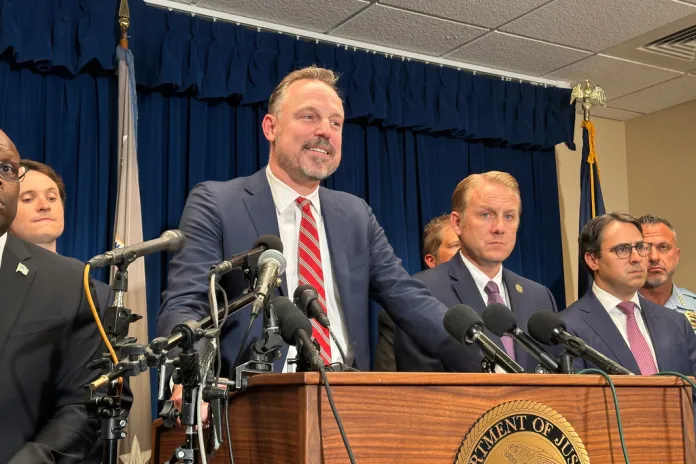
Last month, six senior federal prosecutors departed from the U.S. Attorney’s Office for the District of Minnesota over what the New York Times reported were internal disputes tied to the Trump administration’s directives, though senior officials close to Attorney General Pam Bondi told Fox News that the prosecutors had submitted early retirement paperwork months earlier.
Still, the threat of additional departures from career personnel looms large. During a recent meeting with U.S. Attorney Daniel Rosen, more prosecutors reportedly threatened to resign as he attempted to get his team aligned with the administration’s agenda in the state, according to CNN.
Former federal prosecutor and University of St. Thomas law professor Mark Osler said the recent departures have left fraud cases especially vulnerable.
“When you lose people that are experienced and talented, that’s going to be a problem,” Osler told the Washington Examiner. “And when you lose a lot of them at the same time, it’s going to be a big problem.”
Trump names fraud attorney amid lack of developments in Minnesota
The administration’s most recent effort to address the need to tackle fraud on a national level came last week when Trump announced the appointment of Colin McDonald as the first assistant attorney general for the newly created National Fraud Enforcement Division.
Colin is a rockstar, who was instrumental in our team’s mission of Making America Safe Again. He is a consummate prosecutor who loves God, family, and country and will serve the President and the American people well. https://t.co/Plr4Mz9C3T
— Todd Blanche (@DAGToddBlanche) January 29, 2026
McDonald’s role is designed to centralize and coordinate fraud prosecutions nationwide, and Deputy Attorney General Todd Blanche said McDonald was “instrumental” in the DOJ’s broader crime-fighting efforts.
The announcement followed weeks of heightened attention on Minnesota after independent journalist Nick Shirley released viral reporting in December alleging widespread abuse in the state’s child care and social services systems. Shirley went to dozens of business that exhibited suspicious qualities and raised questions about potentially fraudulent activity.
Since his reporting, however, no major Minnesota-based federal fraud indictments have been announced, even as administration officials and lawmakers have cited estimates suggesting more than $9 billion billed across 14 Medicaid services. To the administration’s credit, there have been other recent fraud busts uncovered in recent days, including the arrest of a Los Angeles man who was accused on Jan. 23 of obtaining $23 million in public money intended to combat homelessness and pocketing $10 million.
On the state level, there has been at least one charging decision against Mohamed Abdirashid Omarxeyd, who is accused of defrauding the Minnesota Medical Assistance program out of more than $3 million. Omarxeyd also faces parallel federal charges stemming from a December indictment.
But the absence of new federal charging activity in Minnesota during January has left the public waiting, as Trump has labeled the state one of the worst in the nation for fraud schemes, tying that claim to the more than 98 individuals in the state who have been charged with fraudulent activities since 2022.
Key experience lost during fraud cases
Osler pointed to the state’s long-running $250 million Feeding Our Future fraud prosecution as a clear example of why staffing losses matter. The case, which began under the Biden administration, exposed massive abuse of COVID-era meal programs and remains one of the most consequential fraud matters in the state.
“That was a serious, serious fraud that needs to be taken seriously — and they did, and they are,” Osler said. “But an ongoing part of it is seeking restitution, trying to get the money back. And that’s something that skill and experience really helps with.”
He compared the loss of seasoned prosecutors to losing a teacher in the middle of a difficult course.
“You probably remember in high school when you had a difficult class like chemistry or physics,” Osler said. “You’re going along through a difficult section, and your teacher gets sick, and then one day you get a substitute.”
Minnesota federal prosecutors last announced major fraud charges in mid-December, accusing six defendants including Omarxeyd of defrauding autism and housing stability programs. However, court records show the case has already suffered from delays, with Omarxeyd’s initial appearance pushed back three times from an initial Jan. 12 appearance, to now a March 2 hearing.
That case was announced at the time by Joe Thompson, an 11-year career attorney in the office who recently served as the acting head of the Minnesota office prior to Rosen. Thompson was among the group of six who left the office last month.
Signs of staffing strains appear in court
The staffing dilemma has surfaced in other recent court cases involving major Minnesota fraud schemes.
On Jan. 20, Assistant U.S. Attorney Katharine Buzicky requested an extension in the case of Sharon Ross, a convicted Feeding Our Future defendant serving a 43-month sentence at a federal prison in Waseca, Minnesota. Buzicky cited new responsibilities stemming from “changes in office staffing,” and a judge granted the request, according to court filings.
Prosecutors are not the only roles needing to be filled in the U.S. attorney’s office. Even its communications staff have exited the building, leaving the public in the dark.
When the Washington Examiner contacted the U.S. attorney’s office on Jan. 20 seeking comment on the status of fraud investigations, an automated email stated it was “currently without a public information officer” and that responses may be delayed. A source familiar with the matter told the Washington Examiner there are currently efforts to hire a replacement, but declined to offer any details about when the spot might be filled.
Osler said such abrupt departures for federal prosecutors are rarely ideological, though a recent report from CNN indicated the earlier wave of resignations was spurred in part by the DOJ’s response to a federal officer’s shooting of Renee Good on Jan. 7, in which senior officials pushed career staff to investigate the actions of her widow in and around the time of Good’s death. The DOJ has pushed back on those claims.
“I don’t know any of their individual reasons for leaving,” Osler said. “But when prosecutors leave abruptly, it’s very often when they’re being asked to do something that they don’t think they can ethically do.”
Current public job listing underpins the hiring strains the office faces. As of this month, USAJobs.gov lists openings for both a criminal assistant U.S. attorney and a civil assistant U.S. attorney in the District of Minnesota.
Over the weekend, White House deputy chief of staff Stephen Miller put out a public call to action over the need for assistant U.S. attorneys in offices across the country. “Reach out. Patriots needed,” he posted to X.
Miller’s post was responding to another sent hours before by Bondi’s former chief of staff Chad Mizelle, who left the department in September. Bondi’s former right-hand man more specifically called for applicants who “support President Trump and anti-crime agenda.”
If you are a lawyer, are interested in being an AUSA, and support President Trump and anti-crime agenda, DM me.
We need good prosecutors. And DOJ is hiring across the country. Now is your chance to join the mission and do good for our country.
— Chad Mizelle (@chad_mizelle) January 31, 2026
“We need good prosecutors. And DOJ is hiring across the country. Now is your chance to join the mission and do good for our country,” Mizelle added.
Walz points to US attorney’s office staffing breakdown
Gov. Tim Walz (D-MN), who has been accused by Republicans of mishandling state resources that led to widespread schemes in his state, publicly acknowledged the staffing problem in the federal prosecutor’s office during a recent appearance on Pod Save America, arguing it has disrupted fraud enforcement.
Tim Walz says the BILLIONS in fraud that robbed Minnesotans happens in every state.
WALZ: “This fraud thing happens in every state…” pic.twitter.com/FpaE4BPa69
— RNC Research (@RNCResearch) January 29, 2026
“This fraud thing happens in every state. We had it here. I take responsibility for it,” Walz said. “We were working hand in hand with the U.S. attorney’s office — that’s gone now. I don’t even know who over there is working on fraud.”
Walz said state officials had been actively cooperating with federal prosecutors before the departures, underscoring how much of the current pace stems from personnel upheaval rather than a lack of investigative leads.
Faster movement on agitators and obstruction
While the U.S. attorney’s officers suffer from retention problems, the DOJ managed to move more efficiently on protest-related enforcement last week.
When Bondi was on the ground in Minnesota last week, she announced 16 defendants were charged in connection with violent assaults on federal officers and property during unrest in Minneapolis. Homeland Security officials have also emphasized investigations into organized efforts to obstruct immigration enforcement.
One day later, the department was able to secure charges against additional defendants related to the Cities Church disruption on Jan. 18, including journalists Don Lemon and Georgia Fort, who partook in joining their protest in an act the DOJ said amounted to a conspiracy against the rights of parishioners and FACE Act violations.
Meanwhile, FBI Director Kash Patel acknowledged this week that the bureau opened an investigation into Signal chat groups only after conservative journalist Cam Higby infiltrated and publicized them. The revelation of the chat, whose members included elected officials and an ally of the Democratic governor, have prompted calls by Trump supporters to prosecute members responsible for coordinating harassment campaigns against federal agents.
Border czar Tom Homan, who recently became the point person for the administration’s immigration enforcement efforts, addressed the Signal investigation during remarks earlier this week.
“I’m not going to say a lot about that because I don’t want to show our hand,” Homan said. “But justice is coming.”
Paul Perez, president of the National Border Patrol Council, echoed that assessment, adding the investigation must extend beyond street-level actors.
“We need to target these groups. We need to go after the funding,” Perez told the National News Desk. “We need to find out exactly where this is being orchestrated from — who’s behind it.”
Deputy Attorney General Blanche on Friday suggested the department’s review of the chat was still on the radar. When pressed by a reporter whether the DOJ was “following the money” behind the organized protests, Blanche said, “I mean, yes.”
But questions among free speech advocacy group leaders remain as to whether the FBI initiative to investigate the chats will bear fruit in the context of quelling the harassment of federal agents, or whether potential prosecutions will even be successful.
Aaron Terr, director of the Foundation for Individual Rights and Expression, told Reason this week there might not be “any lawful basis for this investigation.”
“The First Amendment generally protects the publication of legally-obtained information, including much of what the Trump administration has labeled ‘doxxing.’ That protection extends to using an app to share information about ICE activity,” Terr said.
Staffing woes run up against showdown in Congress next month
The pressure over fraud allegations is set to intensify next month, when Walz and Minnesota Attorney General Keith Ellison are scheduled to testify under oath before the House Oversight Committee.
The appointment of McDonald as DOJ’s new assistant attorney general for national fraud enforcement could potentially improve coordination and handling of fraud cases across the state and the rest of the country, including by temporarily assigning prosecutors from Washington or other offices to help stabilize depleted teams like Minnesota’s. “That kind of coordination can certainly help,” Osler said.
HOUSE OVERSIGHT COMMITTEE SETS DATE FOR TIM WALZ TO TESTIFY
Still, he cautioned that even with a centralized fraud chief in place, it may not be enough to overcome the short term to alleviate the immediate problems of losing personnel who have spent years in the U.S. attorney’s office.
“It’s hard to do that when you’ve lost the talent that could offer that information from this office,” Osler said.


