




The Justice Department on Tuesday asked a federal appeals court to vacate the seditious conspiracy convictions of top Proud Boys and Oath Keepers leaders, marking a sweeping effort to erase some of the most serious criminal judgments stemming from the Jan. 6, 2021, Capitol protest.
In a series of unopposed motions filed with the U.S. Court of Appeals for the District of Columbia Circuit, U.S. Attorney Jeanine Pirro‘s office requested that the court vacate the convictions and send the cases back to a lower court so the government can dismiss the indictments with prejudice.
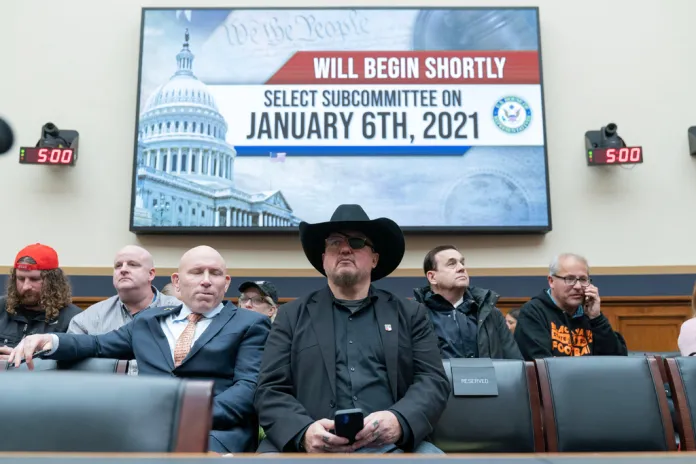
The filings cover multiple groups of defendants, including Proud Boys leaders Ethan Nordean, Joseph Biggs, Zachary Rehl, and Dominic Pezzola, as well as Oath Keepers members such as Roberto Minuta, Edward Vallejo, Joseph Hackett, and David Moerschel. A third motion targets high-profile Oath Keepers leaders, including Stewart Rhodes, Kelly Meggs, Kenneth Harrelson, and Jessica Watkins.
Across all three filings, prosecutors invoked 28 U.S.C. § 2106 and Federal Rule of Criminal Procedure 48(a), asking the appellate court to vacate the convictions before briefing deadlines and remand the cases so the government can dismiss them.
“The government respectfully requests that … the Court vacate [the] convictions … and remand so that the government may move to dismiss the indictment with prejudice,” prosecutors wrote in each motion, citing precedent that allows courts to clear convictions when the executive branch determines dismissal is warranted. All filings were submitted by Pirro and signed by Daniel Lenerz, the assistant U.S. attorney in her office.
The move would go beyond prior clemency actions taken by President Donald Trump, who commuted the sentences of several Jan. 6 defendants but did not issue full pardons. Vacating the convictions would effectively wipe them from the record, preventing future prosecution on the same charges.
The cases represent some of the most consequential prosecutions tied to the Capitol breach. Juries in Washington found the defendants guilty of orchestrating coordinated efforts to disrupt the certification of the 2020 election, including leading groups of supporters toward the Capitol and engaging in confrontations with law enforcement.
In their filings, prosecutors framed the request as an exercise of prosecutorial discretion, arguing that dismissing the cases now serves the “interests of justice.” They pointed to past instances in which courts have granted similar requests when the government seeks to abandon a prosecution after conviction.
PARDONED JAN. 6 PARTICIPANTS DEMAND ‘RETRIBUTION’ IN FIRST COMMEMORATIVE MARCH ON CAPITOL
The motions were filed ahead of key appellate deadlines, including one case in which defendants were scheduled to submit their opening brief as soon as this week. By moving now, the DOJ is attempting to halt the appeals process and resolve the cases outright.
If granted, the court’s action would formally close a major chapter of Jan. 6 litigation, eliminating some of the highest-profile convictions tied to the riot.


