







Federal district court judges reviewing President Donald Trump’s immigration agenda and other contested policies are increasingly being checked by appeals courts, raising questions as to whether some members of the federal judiciary are implementing the law or seeking partisan ends.
The result has created a pattern in which lower courts block administration actions, higher courts narrow or halt those orders, and district judges then revisit the same policies through new procedural routes. The trend has become especially pronounced in immigration cases, where judges are clashing over how much power federal courts have to second-guess Trump administration detention decisions that the Justice Department says Congress placed largely beyond district court review.
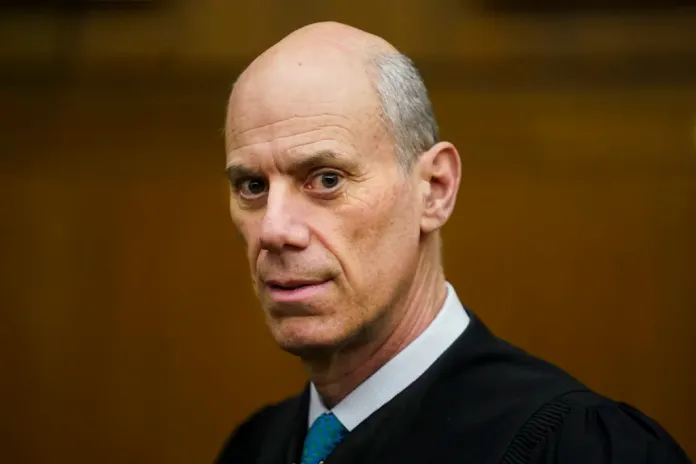
The clearest rebuke came in April, when Chief Judge James Boasberg, an appointee of former President Barack Obama, was ordered by the U.S. Court of Appeals for the D.C. Circuit to end a criminal contempt inquiry into DOJ officials over deportation flights carried out under the Alien Enemies Act last March.
</p>
<p> ” data-image-caption=”</p>
<p>FILE – U.S. District Judge James Boasberg, chief judge of the United States District Court for the District of Columbia, stands for a portrait at E. Barrett Prettyman Federal Courthouse in Washington, March 16, 2023. (Carolyn Van Houten/The Washington Post via AP, File)</p>
<p> ” data-large-file=”https://conservativemodern.com/wp-content/uploads/2026/06/district-court-judges-weighing-trump-policies-face-repeated-slap-downs-by-appeals-courts.webp” src=”https://conservativemodern.com/wp-content/uploads/2026/06/district-court-judges-weighing-trump-policies-face-repeated-slap-downs-by-appeals-courts.webp” alt=”FILE – U.S. District Judge James Boasberg, chief judge of the United States District Court for the District of Columbia, stands for a portrait at E. Barrett Prettyman Federal Courthouse in Washington, March 16, 2023. (Carolyn Van Houten/The Washington Post via AP, File)” class=”wp-image-3356145″ srcset=”https://conservativemodern.com/wp-content/uploads/2026/06/district-court-judges-weighing-trump-policies-face-repeated-slap-downs-by-appeals-courts-1.webp 1024w, https://conservativemodern.com/wp-content/uploads/2026/06/district-court-judges-weighing-trump-policies-face-repeated-slap-downs-by-appeals-courts-1.webp?resize=300,200 300w, https://conservativemodern.com/wp-content/uploads/2026/06/district-court-judges-weighing-trump-policies-face-repeated-slap-downs-by-appeals-courts-1.webp?resize=768,512 768w, https://conservativemodern.com/wp-content/uploads/2026/06/district-court-judges-weighing-trump-policies-face-repeated-slap-downs-by-appeals-courts-1.webp?resize=150,100 150w, https://conservativemodern.com/wp-content/uploads/2026/06/district-court-judges-weighing-trump-policies-face-repeated-slap-downs-by-appeals-courts-1.webp?resize=696,464 696w” sizes=”(max-width: 1024px) 100vw, 1024px”><figcaption class=) U.S. District Judge James Boasberg, chief judge of the United States District Court for the District of Columbia, stands for a portrait at E. Barrett Prettyman Federal Courthouse in Washington, March 16, 2023. (Carolyn Van Houten/The Washington Post via AP, File)
U.S. District Judge James Boasberg, chief judge of the United States District Court for the District of Columbia, stands for a portrait at E. Barrett Prettyman Federal Courthouse in Washington, March 16, 2023. (Carolyn Van Houten/The Washington Post via AP, File)Boasberg had pursued the inquiry after the administration deported alleged Venezuelan gang members to El Salvador despite his temporary restraining order. But the D.C. Circuit issued a writ of mandamus, an extraordinary order used to rein in a lower court, finding that Boasberg’s contempt probe could not continue.
That ruling followed a previous round of appellate intervention against Boasberg in December, and became a prime example for Trump officials and allies who say district judges are not merely ruling against the administration but attempting to influence outcomes even after higher courts have stepped in.
Judge repeatedly tried to stop third-country deportations
Another notable example involves U.S. District Judge Brian Murphy, an appointee of former President Joe Biden in Boston, who blocked the administration’s third-country deportation policy, which allows illegal immigrants to be removed to countries other than their home nations.
After the Supreme Court reversed his decision and allowed the policy to resume last summer, Murphy issued additional orders governing illegal immigrants in February who had been sent through Djibouti while facing possible removal to South Sudan, prompting White House officials to accuse him of refusing to obey the Supreme Court.
When Murphy still tried to enforce his other order that built off the one the Supreme Court lifted — this one blocking the deportation of eight criminal illegal immigrants to South Sudan — the court rebuked him again in a 7-2 unsigned order. Justice Elena Kagan was the lone justice who opposed the initial stay order but switched to join the majority in blocking enforcement of Murphy’s second order, saying she did “not see how a district court can compel compliance with an order that this Court has stayed.”
The pattern repeats in transgender prison case
The same dynamic surfaced in a different policy dispute this week in Washington, D.C., where U.S. District Judge Royce Lamberth, a Reagan appointee, issued a new injunction against the Bureau of Prisons’s policy limiting hormone treatments for transgender-identifying inmates only hours after the D.C. Circuit stayed one of his earlier orders.
</p>
<p> ” data-large-file=”https://conservativemodern.com/wp-content/uploads/2026/06/district-court-judges-weighing-trump-policies-face-repeated-slap-downs-by-appeals-courts.jpg” src=”https://conservativemodern.com/wp-content/uploads/2026/06/district-court-judges-weighing-trump-policies-face-repeated-slap-downs-by-appeals-courts.jpg” alt=”Prison gates.” class=”wp-image-4607479″ srcset=”https://conservativemodern.com/wp-content/uploads/2026/06/district-court-judges-weighing-trump-policies-face-repeated-slap-downs-by-appeals-courts-2.webp 1024w, https://conservativemodern.com/wp-content/uploads/2026/06/district-court-judges-weighing-trump-policies-face-repeated-slap-downs-by-appeals-courts-2.webp?resize=300,200 300w, https://conservativemodern.com/wp-content/uploads/2026/06/district-court-judges-weighing-trump-policies-face-repeated-slap-downs-by-appeals-courts-2.webp?resize=768,512 768w, https://conservativemodern.com/wp-content/uploads/2026/06/district-court-judges-weighing-trump-policies-face-repeated-slap-downs-by-appeals-courts-2.webp?resize=150,100 150w, https://conservativemodern.com/wp-content/uploads/2026/06/district-court-judges-weighing-trump-policies-face-repeated-slap-downs-by-appeals-courts-2.webp?resize=696,464 696w” sizes=”(max-width: 1024px) 100vw, 1024px”><figcaption class=) (Getty Images)
(Getty Images)Lamberth concluded the BOP policy could still be blocked under the Administrative Procedure Act, even as the appeals court found the executive order that formed the basis of that policy was likely to survive review.
This pernicious pattern has become a form of legal Whack-A-Mole. An appeals court narrows one injunction, only for a district judge to issue a new order based on a different statute, record, or legal theory.
But the most consequential front may be immigration detention, where a fast-moving circuit split is putting Trump’s no-bond policy on a likely path to the Supreme Court after more than 13,000 instances in which federal judges concluded that Immigration and Customs Enforcement illegally detained illegal immigrants.
Two former immigration judges weigh in on the problems beneath the surface
The dispute stems from a July 2025 ICE memo and a September 2025 Board of Immigration Appeals ruling known as “Matter of Jonathan Javier Yajure Hurtado,” which concluded that illegal immigrants who entered the country without being formally admitted are designated as “applicants for admission” under federal law, regardless of when they entered the country.
That distinction matters because the administration says those immigrants qualify for mandatory detention under Section 1225 of the Immigration and Nationality Act, rather than discretionary detention under Section 1226, which historically allowed immigration judges to consider bond.
Immigration activists contend the shifts under this administration have effectively removed bond eligibility for many illegal immigrants arrested inside the country, including some who had lived in the United States for years.
Former immigration judge Lawrence Burman, who retired in December, argued the nationwide battle over immigration detention is not a simple case of anti-Trump judges resisting enforcement, unlike several lawsuits brought in Washington, D.C., where a federal judge quickly ties the hands of the administration before weighing the merits of the case.
“This is not just a case of things like the reflecting pool, where the judge issues an injunction for no good reason, just because they don’t like Trump,” Burman told the Washington Examiner. “This is a serious issue.”
Burman said the administration is trying to treat long-term illegal immigrants as though they had just arrived at the border, even though immigration law historically distinguished between “exclusion proceedings” for new arrivals and deportation proceedings for people already inside the country.
“What the government is trying to do is make it impossible for people to get bonds in almost every situation where you’re an alien,” Burman said. He added that district judges “are almost all pushing back on it really hard, and not just the crazy ones.”
Despite Burman’s contention, there are other former immigration judges who see the issue in an entirely different light. They say the Trump administration is enforcing laws that have been on the books for decades.
Art Arthur, a former immigration judge and fellow at the Center for Immigration Studies, offered a measured disagreement, saying the administration is enforcing a statutory structure Congress created in 1996, but one that prior administrations merely declined to apply fully.
If you don’t like the rules, take it up with Congress
Before 1996, Arthur said, enforcement of immigration law turned on whether an immigrant had “entered” the country. If someone crossed illegally and made it into the interior, that person could often seek bond. But the Illegal Immigration Reform and Immigrant Responsibility Act of 1996 replaced that framework with a distinction between immigrants who had been legally “admitted” and those who had not.
“Congress makes the rules,” Arthur told the Washington Examiner. “If Congress has said they’re supposed to be detained, they’re supposed to be detained.”
Arthur said the Clinton, George W. Bush, Obama, and Biden administrations all stopped short of applying the 1996 law to its full extent, in part because of detention capacity limitations and policy preferences. He argued the Trump administration, especially after the Laken Riley Act and the Supreme Court’s overturning of Chevron, is forcing courts to confront the text Congress enacted.
Most importantly, limiting bond options for detainees did not arise out of a vacuum, nor did it originate in Washington under Trump. Rather, it actually gained steam three years ago in Tacoma, Washington, where four immigration judges at the Northwest ICE Processing Center concluded in 2023 that Congress never gave them authority to grant bond to certain immigrants who entered illegally.
One of them, Charles Neil Floyd, later became the top federal prosecutor in Seattle during Trump’s second term and is currently serving as the first assistant U.S. attorney in Washington.
That regional practice drew little national attention until the Trump administration adopted a similar theory nationwide when the president returned to office.
After more than 400,000 interior arrests of illegal immigrants and over 60,000 currently in detention, appeals courts are now more divided than ever. The 5th Circuit sided with the administration in February in Buenrostro-Mendez v. Bondi, holding that the statutory text supports mandatory detention for immigrants who entered without inspection. The 8th Circuit reached a similar conclusion the following month.
But the 2nd Circuit in April became the first appellate court to reject the administration’s position, warning it could create “the broadest mass-detention-without-bond mandate in our Nation’s history.” The 11th Circuit followed in May, and days later the 6th Circuit joined them, preserving bond hearings for at least some detainees arrested inside the country.
The growing divide has created a 3-2 circuit split against the administration and is widely viewed as placing the issue on a fast track to Supreme Court review.
District judges have also begun examining the bond hearings that do occur, reviewing whether immigration judges considered evidence, applied the correct burden of proof, or treated federal court orders as meaningful rather than perfunctory.
U.S. District Judge Kyle Dudek, a Trump appointee in Florida, on June 11 accused administration lawyers of a “masterclass in litigation cynicism” after an immigration judge failed to hold a court-ordered bond hearing.
U.S. District Judge Susan Wigenton, a George W. Bush appointee in New Jersey, ordered a new hearing before a different immigration judge after finding that evidence had not been considered.
Notably, several of the sharpest criticisms of immigration detention practices have come from Republican-appointed judges, underscoring that the dispute has not broken neatly along partisan lines.
Still, Arthur argued district courts are increasingly inserting themselves into immigration decisions that Congress largely shielded from their review.
“There’s a reason that Congress cut district courts out of review of immigration issues,” Arthur said. “With due respect to anybody who’s been a district court judge, they don’t have any expertise in the area.”
NEARLY 900,000 DEPORTED BY ICE UNDER TRUMP AS FLIGHTS SOARED IN MAY TO NEW HIGH
The Supreme Court has already shown impatience with nationwide injunctions and district court control over national policy during the second Trump administration.
Ultimately, the detention feud happening in courts across the nation presents a more difficult question of whether district judges are improperly acting as immigration appeals courts, or if they are legitimately using habeas corpus to police unlawful confinement, a matter that will surely require review by the nine justices sooner rather than later.


