







A Democratic National Committee panel on Thursday declined to advance a resolution criticizing the expanding role of dark money and corporate-funded outside groups in Democratic elections, with particular attention to the American Israel Public Affairs Committee.
The proposal was considered at the DNC’s spring meeting in New Orleans, where the resolutions committee tabled the measure. Though the resolution was nonbinding, it came amid heightened scrutiny of pro-Israel advocacy groups as midterm election campaigns intensify.
The measure, introduced by Florida DNC member Allison Minnerly, warned that heavy outside spending tied to candidates’ positions on foreign policy could distort political debate and limit elected officials’ responsiveness to their constituents.
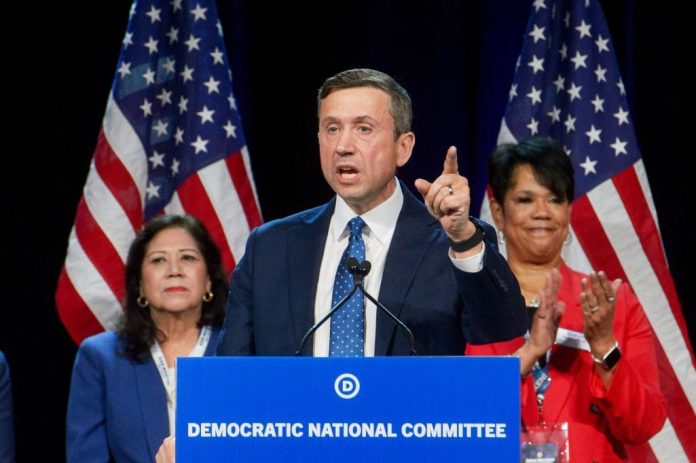
Minnerly argued there was “merit to calling out different PACs with intention,” adding that “Democrats overwhelmingly want a party that stands for human rights and against increased conflict in the Middle East.”
Minnerly’s measure specifically highlighted AIPAC’s roughly $14 million in spending during last month’s Illinois Democratic primaries.
In the aftermath of those contests, Gov. JB Pritzker (D-IL), a former AIPAC donor, publicly criticized the group, reflecting a broader shift among some Democrats who have grown increasingly wary of its electoral involvement.
While the panel ultimately backed a more general resolution addressing the influence of outside money in the 2026 Democratic primaries, it stopped short of singling out AIPAC or explicitly calling for rejecting its financial support, even as concerns about such spending loomed over the discussion.
Minnerly unsuccessfully pushed for an arms embargo on Israel last year.
Party officials have grappled with tensions over AIPAC and Israel before, with disastrous results. Internal reviews following the 2024 election indicated that Democrats’ handling of the Gaza conflict may have hurt their presidential ticket, though it remains unclear whether those findings were included in a report the DNC ultimately chose not to publish.
“They should release it, I’m all for transparency,” Rep. Ro Khanna (D-CA), a possible contender for president in 2028, told the Washington Examiner earlier this year.
DEMOCRATS ON TRACK TO LOSE THEIR DARK MONEY ‘SECURITY BLANKET’
In December, DNC Chairman Ken Martin declined to make the report public, claiming it would be a “distraction” for the party, which lost control of the Senate and the White House in 2024.
Two other resolutions on placing conditions on military aid to Israel and recognizing a Palestinian state were referred to the DNC’s Middle East Working Group.


