



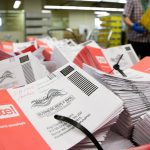


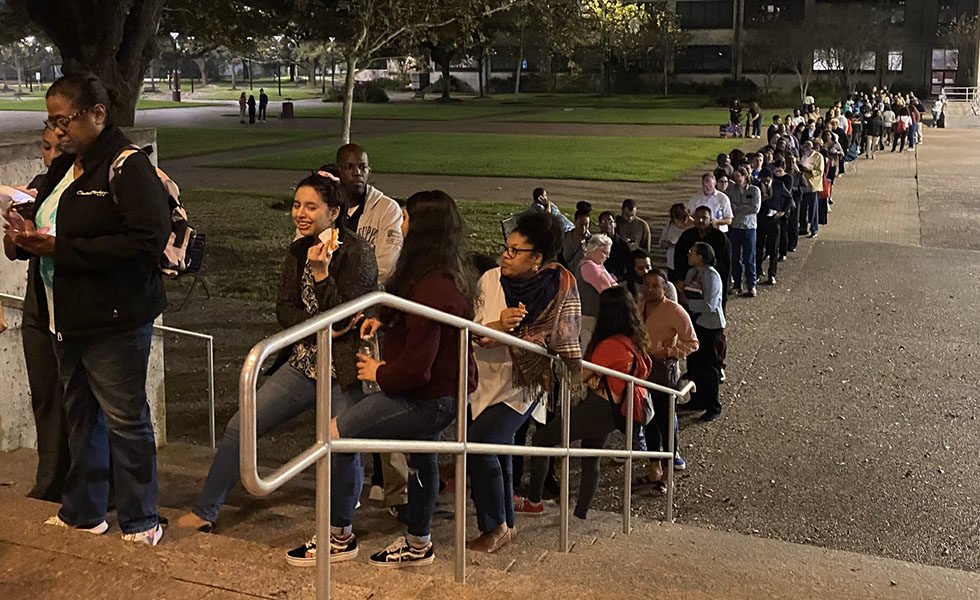
Democratic voter turnout surged on Super Tuesday, exceeding 2016 levels in at least a dozen states and setting an all-time record in one of them.
In Virginia, the fourth most delegate-rich state to hold a primary Tuesday, more than 1.3 million voters cast ballots — a nearly 70 percent increase over 2016, when about 783,000 voted in the Democratic presidential primary. That surpasses a previous record set in 2008, when just under 1 million voters turned out.
In North Carolina, turnout was up by about 17 percent over 2016 levels. And in Texas, at least 45 percent more voters went to the polls on Tuesday than showed up four years ago, according to an analysis of vote returns.
Turnout also skyrocketed in contests in Colorado, Maine, Minnesota and Utah, though those states switched from caucuses to primaries this year, making it difficult to compare Tuesday’s turnout to that of past election years.
Halima Salman convicted of receiving ISIS military training in Syria, faces 10 years in prison
Harley-Davidson’s Decade-Long Electric Motorcycle Initiative Has Turned Disastrous
Rock Legend Donnie Iris Dies Less Than Three Weeks After Retiring from Performing
Federal officials identify 400 noncitizens registered to vote in Washington state: ‘Tip of the iceberg’
Cassidy Hutchinson avoids indictment after DOJ effort to charge her over Jan 6 testimony fails: sources
Man accused of threatening to hijack United flight says it was a drunken joke
Watch: Outrageous Pro-El-Sayed Ad Blames Jewish State for Raising Price of Bananas, Eggs in Michigan
Haitian illegal immigrant charged in Walmart killing entered US via Biden parole program: DHS
Flavio Bolsonaro to be issued visa by State Department after fleeing Brazil
Right-Wing Presidential Candidate Flavio Bolsonaro Secretly Flees Brazil for US After Disputed Election: Report
Luxury real estate brothers sentenced to 30 years in prison for yearslong sex-trafficking scheme
Judge who apologized to accused would-be Trump assassin lights up DOJ in Hunter Biden FBI case
Jordanian Military Goes After Targets in Syria in Response to Terrorists Killing Christians
‘Beloved’ daredevils who scaled Empire State Building inching toward deal after proposal stunt: attorney
Judge slams federal prosecutors over new charges against ex-FBI officials
The gains are an early sign of enthusiasm among Democratic voters as they look to recapture the White House from President Trump.
“If I was in the White House or I was in Trump’s campaign looking at poll numbers right now, I would be absolutely terrified,” said Michael Starr Hopkins, a Democratic strategist. “I don’t see how — with the wind at [former Vice President Joe] Biden’s back and the kind of turnout we’re seeing — Trump is just going to run away with this election.”
In only one state did turnout decrease from its 2016 levels: Oklahoma. Fewer than than 304,000 voters cast ballots in the Sooner State’s Democratic primary on Tuesday. That’s down from about 335,000 four years ago.
To be sure, votes in several states were still being tallied on Wednesday. In California, where roughly 3 million votes have already been tallied, millions more ballots are expected to be counted, and county election officials have until the close of business on Thursday to report how many votes they have left to count.
The increased voter turnout on Tuesday was driven largely by moderates, who helped deliver several key victories to Biden.
The former vice president’s campaign has rebounded in recent days after he notched a decisive victory in the South Carolina primary on Saturday, a win driven in large part by strong turnout from moderates and black voters, who made up a majority of the state’s Democratic electorate.
That win combined with the exits from the race of former South Bend, Ind., Mayor Pete Buttigieg and Sen. Amy Klobuchar (D-Minn.) helped Biden consolidate the support of moderate voters, many of whom remain wary of nominating Sen. Bernie Sanders (I-Vt.), a self-described democratic socialist.
Halima Salman convicted of receiving ISIS military training in Syria, faces 10 years in prison
Harley-Davidson’s Decade-Long Electric Motorcycle Initiative Has Turned Disastrous
Rock Legend Donnie Iris Dies Less Than Three Weeks After Retiring from Performing
Federal officials identify 400 noncitizens registered to vote in Washington state: ‘Tip of the iceberg’
Cassidy Hutchinson avoids indictment after DOJ effort to charge her over Jan 6 testimony fails: sources
Man accused of threatening to hijack United flight says it was a drunken joke
Watch: Outrageous Pro-El-Sayed Ad Blames Jewish State for Raising Price of Bananas, Eggs in Michigan
Haitian illegal immigrant charged in Walmart killing entered US via Biden parole program: DHS
Flavio Bolsonaro to be issued visa by State Department after fleeing Brazil
Right-Wing Presidential Candidate Flavio Bolsonaro Secretly Flees Brazil for US After Disputed Election: Report
Luxury real estate brothers sentenced to 30 years in prison for yearslong sex-trafficking scheme
Judge who apologized to accused would-be Trump assassin lights up DOJ in Hunter Biden FBI case
Jordanian Military Goes After Targets in Syria in Response to Terrorists Killing Christians
‘Beloved’ daredevils who scaled Empire State Building inching toward deal after proposal stunt: attorney
Judge slams federal prosecutors over new charges against ex-FBI officials
In Texas, roughly 43 percent of the electorate on Tuesday self-identified as moderate, according to exit polling. That’s a nearly 10-point increase over 2016, when about 34 percent described themselves as moderate. That trend was also seen across Virginia, North Carolina, Alabama and Massachusetts, where Biden scored an unexpected first-place finish.
That surge in moderate turnout likely worked to the detriment of Sanders, who has long argued that high turnout, particularly from young voters, would yield electoral wins for his campaign.
But those young voters did not turn out on Tuesday at the rate that Sanders had hoped. Exit polls show that the Vermont senator won voters between the ages of 18 and 29 by wide margins across the 14 Super Tuesday states. But no state saw an increase in those voters’ share of the electorate.
“Any candidate who relies on college-aged voters to push them across the finish line is usually disappointed,” Hopkins, the Democratic strategist, said.
“The 35-and-up, 65-and-up voters — they vote. They consistently vote,” he added. “They show up to the polls. They wait in line. And that’s going to be Sanders’s long-term problem.”
Sanders scored four wins, including one in his home state of Vermont and a decisive victory in California, the largest delegate prize of the primary contest. But he also saw his share of the vote decrease in several states, where moderates turned out in force.
In Oklahoma, a state Sanders carried in his 2016 primary bid against Hillary Clinton, Biden bested Sanders by 13 points. At the same time, the share of moderate voters in the state’s primary surged by 15 points, jumping from about 36 percent four years ago to 51 percent on Tuesday, exit polls show.
In a victory speech in Los Angeles on Tuesday, Biden touted the primary returns as evidence that he had built the broadest coalition of any candidate in the nominating contest, noting that the increased voter turnout had allowed him to run up the score on Super Tuesday.
“People are talking about a revolution,” Biden said, delivering an implicit jab at Sanders and his message of political revolution. “We’ve increased turnout. They turned out for us.”
Story cited here.


