







European leaders of all stripes are tense at the prospect of a second invasion into Ceuta as Morocco tightens security amid online campaigns to rally another mob across the border.
Social media posts calling for Moroccan citizens to launch another mass invasion of the Spanish territory are percolating across the internet. Spanish Defense Minister Margarita Robles warns that the border remains closed and any such attempts will be repelled. But that assurance has done little to assuage panic in the European Union that Spain will be the entry point for a flood of migrants.
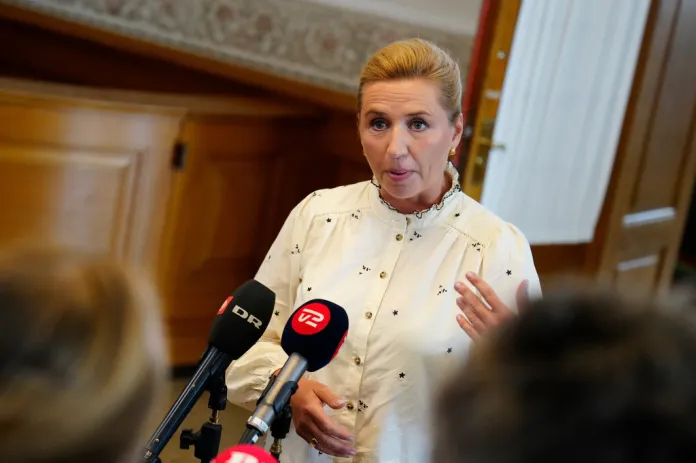
Danish Prime Minister Mette Frederiksen, a center-left politician who rose to power with a platform decrying mass immigration, told her parliament that Europe is facing an existential threat from “people who sympathize with some of the darkest forces in this world.”
“If we talk about undemocratic forces, yes, then Russia is our biggest enemy. The problem is that a major enemy has started to grow from within, and it is foreigners who have come to Europe,” Frederiksen said. “It is Hamas supporters. It is people who commit terror against European societies. It is people who do not recognise our fundamental European values.”
</p>
<p> ” data-large-file=”https://conservativemodern.com/wp-content/uploads/2026/08/danish-pm-calls-migrants-with-islamic-background-the-greatest-threat-as-europe-braces-for-second-migrant-wave.webp” src=”https://conservativemodern.com/wp-content/uploads/2026/08/danish-pm-calls-migrants-with-islamic-background-the-greatest-threat-as-europe-braces-for-second-migrant-wave.webp” alt=”Mette Frederiksen” class=”wp-image-4687624″ srcset=”https://conservativemodern.com/wp-content/uploads/2026/08/danish-pm-calls-migrants-with-islamic-background-the-greatest-threat-as-europe-braces-for-second-migrant-wave-2.webp 1024w, https://conservativemodern.com/wp-content/uploads/2026/08/danish-pm-calls-migrants-with-islamic-background-the-greatest-threat-as-europe-braces-for-second-migrant-wave-2.webp?resize=300,200 300w, https://conservativemodern.com/wp-content/uploads/2026/08/danish-pm-calls-migrants-with-islamic-background-the-greatest-threat-as-europe-braces-for-second-migrant-wave-2.webp?resize=768,512 768w, https://conservativemodern.com/wp-content/uploads/2026/08/danish-pm-calls-migrants-with-islamic-background-the-greatest-threat-as-europe-braces-for-second-migrant-wave-2.webp?resize=150,100 150w, https://conservativemodern.com/wp-content/uploads/2026/08/danish-pm-calls-migrants-with-islamic-background-the-greatest-threat-as-europe-braces-for-second-migrant-wave-2.webp?resize=696,464 696w” sizes=”(max-width: 1024px) 100vw, 1024px”><figcaption class=) Denmark’s Prime Minister Mette Frederiksen speaks to the media, prior to a meeting in parliament, in Copenhagen, Wednesday, Aug. 12, 2026. (Sebastian Elias Uth/Ritzau Scanpix via AP)
Denmark’s Prime Minister Mette Frederiksen speaks to the media, prior to a meeting in parliament, in Copenhagen, Wednesday, Aug. 12, 2026. (Sebastian Elias Uth/Ritzau Scanpix via AP)“So Europe is threatened,” she continued. “The problem is that we are threatened both from outside and now from within […] Because of people with an Islamic background who do not want the open, free European society. Unfortunately.”
Last month, approximately 72,000 Moroccan migrants stormed through borders and swam across bodies of water to enter Ceuta, which is a part of Spain located on the northern tip of Africa. These invaders were reportedly inspired by social media rumors that the border between Morocco and Spain was open.
Spain claims 70,000 of these illegal entrants have returned home or been detained and deported. The vivid chaos is bringing unpleasant attention to Spain’s broader relationship with immigration and sparking fear that the southern European state cannot be trusted by the rest of the European Union on the issue.
The European Commission has deployed a team of migration experts to the Spanish territory to conduct a “first-hand assessment” of border security and “understand the first-hand needs on the ground.”
“For us, it’s not about a specific date. It’s about reinforcing our borders and ensuring returns every day of the year,” a European Commission spokesperson said.
Last week, Italy imposed border checks with Spain to ensure undocumented individuals could not enter. Outraged by this policy, Spain vaguely threatened retaliation, but Rome was unbothered.
“Italy does not accept ultimatums or demands from abroad regarding national security and border control,” Italian Prime Minister Giorgia Meloni’s office said.
Multiple European leaders, including Frederiksen and Meloni, called for Spain to be suspended from the Schengen Area earlier this month until its migration system can be normalized and secured. Finnish Interior Minister Mari Rantanen made such a demand, saying Spain “completely failed” to protect the EU’s borders. Czech Prime Minister Andrej Babis suggested the same.
</p>
<p> ” data-large-file=”https://conservativemodern.com/wp-content/uploads/2026/08/danish-pm-calls-migrants-with-islamic-background-the-greatest-threat-as-europe-braces-for-second-migrant-wave-1.webp” src=”https://conservativemodern.com/wp-content/uploads/2026/08/danish-pm-calls-migrants-with-islamic-background-the-greatest-threat-as-europe-braces-for-second-migrant-wave-1.webp” alt=”Ceuta migrant holding sign” class=”wp-image-4687628″ srcset=”https://conservativemodern.com/wp-content/uploads/2026/08/danish-pm-calls-migrants-with-islamic-background-the-greatest-threat-as-europe-braces-for-second-migrant-wave-3.webp 1024w, https://conservativemodern.com/wp-content/uploads/2026/08/danish-pm-calls-migrants-with-islamic-background-the-greatest-threat-as-europe-braces-for-second-migrant-wave-3.webp?resize=300,200 300w, https://conservativemodern.com/wp-content/uploads/2026/08/danish-pm-calls-migrants-with-islamic-background-the-greatest-threat-as-europe-braces-for-second-migrant-wave-3.webp?resize=768,512 768w, https://conservativemodern.com/wp-content/uploads/2026/08/danish-pm-calls-migrants-with-islamic-background-the-greatest-threat-as-europe-braces-for-second-migrant-wave-3.webp?resize=150,100 150w, https://conservativemodern.com/wp-content/uploads/2026/08/danish-pm-calls-migrants-with-islamic-background-the-greatest-threat-as-europe-braces-for-second-migrant-wave-3.webp?resize=696,464 696w” sizes=”(max-width: 1024px) 100vw, 1024px”><figcaption class=) A migrant who crossed from Morocco into Spain holds a sign reading, in Spanish, “asylum” as he lines up for food distribution on a beach in the Spanish enclave of Ceuta, Monday, Aug. 3, 2026. (AP Photo/Bernat Armangue)
A migrant who crossed from Morocco into Spain holds a sign reading, in Spanish, “asylum” as he lines up for food distribution on a beach in the Spanish enclave of Ceuta, Monday, Aug. 3, 2026. (AP Photo/Bernat Armangue)Spanish Prime Minister Pedro Sanchez, an avowed socialist who has penned op-eds in U.S. publications about how the “West needs migrants,” has condemned the critical responses from his fellow EU member states. He called the idea of penalizing Spain over the invasion “selfish, polarising and unlawful” at a time when the nation most needs help.
But Spain’s handling of illegal immigration, among the most important issues for voters across Europe, was already causing concern before the Ceuta crisis.
Sanchez’s government in June rolled out a mass amnesty program for foreign nationals illegally living and working in Spain. The program offered an avenue for illegal immigrants to obtain legal residency status and work permits.
THE REVERSE RECONQUISTA: HOW 60,000 MOROCCAN MEN EXPOSED EUROPE’S SOFTEST BORDER
The program grants a one-year residence permit to illegal migrants who have been living in Spain for at least five months before the end of 2025. Applicants were also required to have a clean criminal record. The one-year permits are renewable.
Spain expected 500,000 illegal immigrants to apply for the program, but a whopping 1.2 million individuals came forward seeking legal status.


