




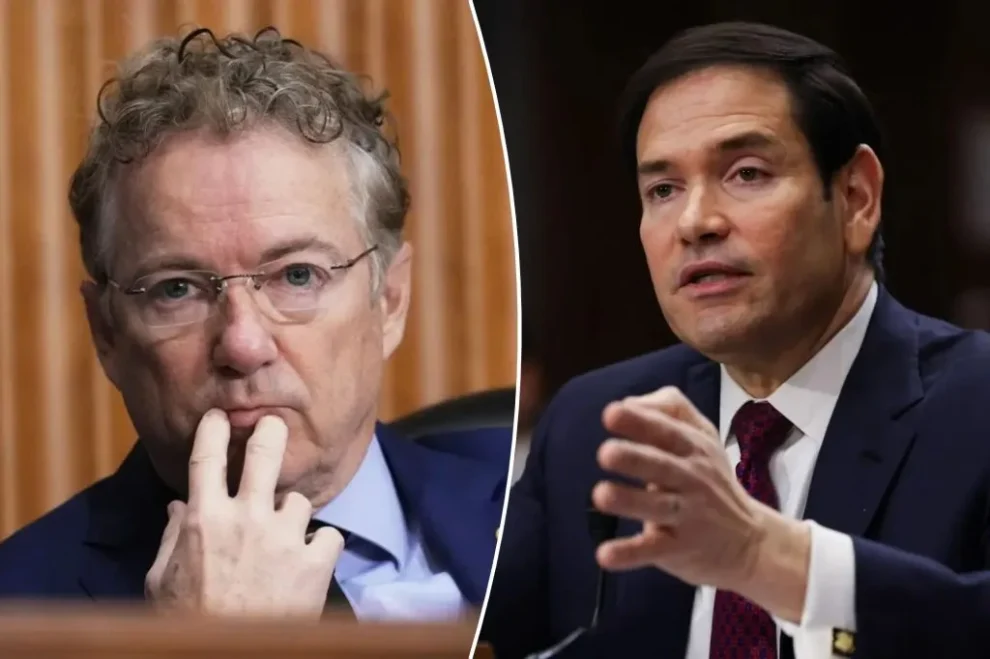
Secretary of State Marco Rubio mounted a strong defense of the so-called “Donroe Doctrine” during Wednesday’s marathon session with the Senate Foreign Relations Committee.
Rubio, with his trademark assurance, fielded questions on Venezuela, Iran, Greenland, and much more. The appearance came at a pivotal moment for President Donald Trump’s foreign policy agenda, which has dominated headlines since he returned to the White House.
Here are five top takeaways from Rubio’s hearing:
1. Rubio defends Maduro’s capture
Rubio, anticipating that the committee would be interested in the administration’s strategy for Venezuela, opened the hearing by speaking off the cuff as to what comes next after the Jan. 3 capture of former dictator Nicolas Maduro.
Rubio remained adamant that the administration has a three-phase approach to a “friendly, stable, and prosperous” Venezuela, which starts with the country’s stabilization before pivoting to its “recovery.”
“It was an enormous strategic risk for the United States, not halfway around the world, not in another continent, but in the hemisphere in which we all live,” he said of Venezuela. “It was having dramatic impacts on us, but also on Colombia and on the Caribbean Basin, and all sorts of other places. It was an untenable situation, and it had to be addressed. And it was addressed.”
Rubio sought to counter concerns related to the prospect of a “forever war,” contending the administration has been “making good and decent progress” and that “we are certainly better off today in Venezuela than we were four weeks ago.”
To that end, Rubio previewed that the U.S. would have a diplomatic presence in Venezuela led by Laura Dogu, the former U.S. Ambassador to Nicaragua and Honduras. This comes amid the slower-than-expected release of Maduro’s political prisoners and uncertainty about a timeline for new democratic elections.
Although there were questions about the lack of congressional consultation before Maduro’s capture, many of the lawmakers were concerned about the administration’s management of Venezuelan oil reserves, with revenue being held in offshore bank accounts in Qatar.
“We’re using that short-term mechanism both to stabilize the country, but also to make sure that the oil proceeds that are currently being generated through the licenses we’ll now begin to issue on the sanctioned oil goes to the benefit of the Venezuelan people, not to fund the system that existed in the past,” Rubio said.
That did not stop Sen. Rand Paul (R-KY) from criticizing the administration’s actions in Venezuela as “an act of war.”
“We didn’t remove an elected official,” Rubio said. “We removed someone who was not elected, and it was actually an indicted drug trafficker in the United States.”
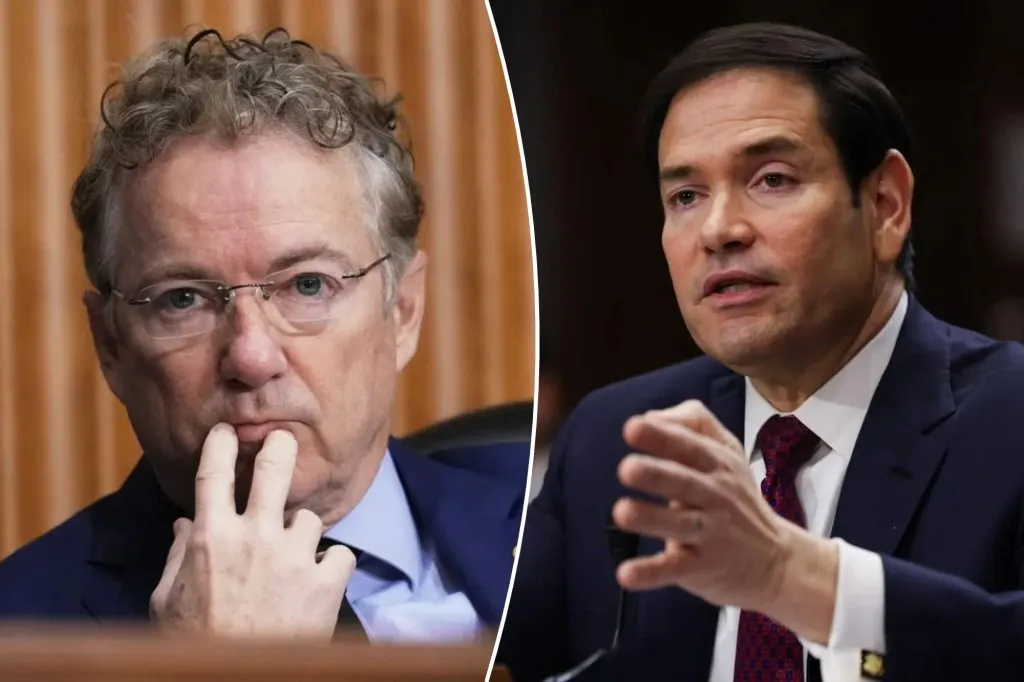
Rubio asserted that Operation Absolute Resolve was “certainly startling to China, to Russia, to Iran, to any adversary around the world” because the U.S. is “the only country in the world that could have done this.”
The secretary was also candid about what Maduro’s capture could mean for Cuba, telling the committee Trump supported regime change there, though he did not commit to it being instigated by the administration.
“There’s no doubt about the fact that it would be of great benefit to the United States if Cuba was no longer governed by an autocratic regime,” he said.
2. Rubio: NATO must be ‘reimagined’
Senate Foreign Relations Committee ranking member Jeanne Shaheen (D-NH) used her opportunity for questions to press Rubio on the administration’s commitment to NATO one week after the alliance appeared on the precipice of collapse over Trump’s demands for Greenland, a Danish territory.
Rubio downplayed Trump’s criticisms of NATO as having precedent among his predecessors, claiming only that “this president complains about it louder than other presidents” before adding that NATO “needs to be reimagined.”
“Our like-minded partners have to have capability,” the secretary said, adding that much of Europe has prioritized defense spending in favor of “social programs” and that Spain, for example, is still not spending 5% of its GDP on defense.
“Without the U.S., there is no NATO, and we understand that in order for NATO to be stronger, our partners need to be stronger,” he continued. “One of the things we’ve explained to our allies in NATO is the United States is not simply focused on Europe. We also have defense needs in the Western Hemisphere. We have defense needs in the Indo-Pacific… We may be the richest country in the world, but we don’t have unlimited resources.”
On Greenland, Rubio said the U.S. and Denmark were in a “good place right now” amid “technical-level meetings” as part of a “process that’s going to bring us to a good outcome for everybody.”
“We’re going to try to do it in a way that isn’t like a media circus every time these conversations happen, because we think that creates more flexibility on both sides to arrive at a positive outcome. And I think we’re going to get there,” he said.
3. Rubio: Iran ‘probably weaker’ than ever
Regarding Iran, Rubio told the committee his assessment is that Supreme Leader Ali Khamenei’s regime is “probably weaker than it has ever been” after weeks of protests.
“The core problem they face, unlike the protests you saw in the past on some other topics, is that they don’t have a way to address the core complaints of the protesters, which is that their economy is in collapse,” he said.
To that end, Rubio underscored that Iran’s economy is crumbling because the regime has spent “all their money and all their resources building weapons and sponsoring terrorist groups around the world, instead of reinvesting it back into their society.”
“The protests may have ebbed, but they will spark up again in the future because this regime, unless they are willing to change and/or leave, have no way of addressing the legitimate and consistent complaints of the people of Iran who deserve better,” he said.
Rubio’s appearance came as Trump on Tuesday spoke openly about the “massive armada” he has deployed to Iran after threatening military action in response to Khamenei’s crackdown on protests and demands for a new nuclear deal.
4. Rubio: Taiwan is ‘Xi’s legacy project’
Rubio reiterated that, despite the criticism, the U.S.’s perceived withdrawal from Europe is in response to the administration’s acknowledgement of national security threats posed by other parts of the world, including China.
While underscoring the Trump administration’s “competitor, not adversary” strategy regarding China, Rubio described Chinese President Xi Jinping’s desire for more control over Taiwan as almost inevitable as part of Xi’s “legacy project.”
“He’s made very clear that that’s what he intends to do, and that’s going to be irrespective of anything that happens in the world,” Rubio said of Xi when asked whether there was a message for China in the administration’s capture of Maduro.
5. Rubio leverages relationships, reduces tension with Democrats
Rubio appeared to take advantage of his Senate experience to minimize tensions, particularly with Democratic members of the committee. At times, he wrote down their multipart questions so he could respond to them all.
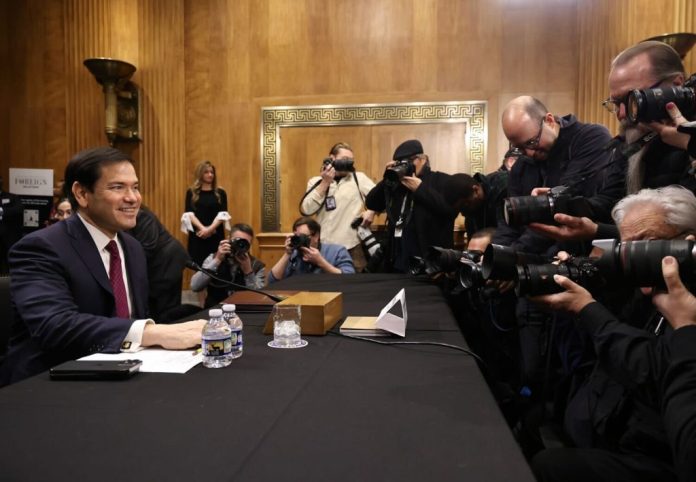
The most pointed Democratic questioning came from the likes of Sen. Tim Kaine (D-VA), who criticized Rubio for only making himself available to the panel “five months” into the U.S.’s aggressive strategy regarding so-called “narco-terrorists” off the coast of Venezuela before the administration’s capture of Maduro.
“I’d like to talk about the complete weakness of the legal rationale about the strikes on boats in international waters, but I can’t because the administration has only shared it with members in a classified setting,” Kaine said.
Kaine also sought to clarify whether Trump confused Greenland and Iceland during his remarks last week to the World Economic Forum in Davos, Switzerland.
“Yeah, he meant to say Greenland,” Rubio said. “But I think we’re all familiar with presidents that have verbal stumbles. We’ve had presidents like that before.”
Similarly, Rubio defended the administration’s decision not to seek congressional approval before Maduro’s capture. He described it as a “trigger”-based mission, though he did concede he underscored the importance of consulting Congress when he was in their position.
On multiple occasions, Democrats expressed agreement with some of the Trump administration’s foreign policy, especially its opposition to Maduro and its call for European countries to contribute more to NATO.
RUBIO’S ABILITY TO SIT OUT THE MINNEAPOLIS PR CRISIS IS A LUXURY AS 2028 LOOMS
“I must say that you said something I like,” Sen. Jeff Merkley (D-OR) said of the administration’s commitment that no taxpayer dollars will be spent to “prop up Venezuela.”
Rubio quipped in response, “I’m making progress.”


