




Closing arguments took place in the Lindsay Clancy case Thursday, bringing an end to a weekslong trial in which jurors will now determine whether the Massachusetts mother is criminally responsible for murdering her three young children.
The former labor and delivery nurse admits she killed her children in January 2023 but argues she is not responsible because of claims she was in a psychotic state.
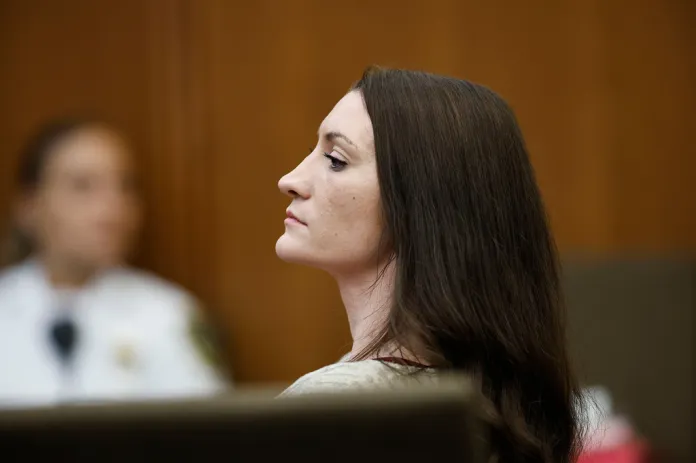
The prosecution and the defense offered closing arguments to the jury at Plymouth Superior Court, bringing an end to the murder trial after five weeks of testimony from around 80 witnesses. At times, Clancy was stoic, looking straight ahead. At other times, she was visibly emotional, crying and wiping her eyes.
The defense’s position
Clancy’s defense, led by attorney Kevin Reddington, argued she should not be criminally liable because of assertions that the killings were brought on by postpartum psychosis, a severe mental health condition that was poorly managed by doctors who prescribed her over a dozen medications with possibly dangerous side effects. He emphasized the words of Dr. Phillip Resnick, who testified that Clancy was in a state of psychosis at the time of the murders, “times three.” He further cited one of the prosecution’s own witnesses, forensic psychologist Kirk Heilbrun, a prosecution witness, who told the jury, “it’s possible either way,” according to Reddington.
“That’s not proof beyond a reasonable doubt,” the attorney said.
He also emphasized Clancy’s suicide attempt, which she said she sought to carry out after killing her children, arguing testimony proved “that this was a legitimate, dreadful, horrific suicide attempt.”
“Because of the damn medicine and the lousy medical care that she got,” Reddington said, “this young lady did nothing wrong in her life. … She was a nurse, a daughter, a wife, and a darn good mother.”
Reddington said handwritten notes from Clancy proved the devolution of her mental state in the fall and winter of 2022. By December, her journal was “chicken scratches because her mind is gone,” he said.
Reddington disputed the prosecution’s take on the elastic workout bands Clancy used to strangle her children. The attorney said Patrick testified that when he found the children, the elastic bands were tied in knots around their necks, and he struggled to untie them. The defense has said Patrick did not testify that there were knots, arguing it is an indicator she held the elastic bands around her children’s necks for minutes as they died.
Reddington also argued searches for how long it would take for her husband to pick up takeout and medicine prior to the killings were not evidence of guilt or premeditation, as the prosecution has argued.
“She didn’t want him out of the house long. She was in distress,” he said. “She wanted him home to help with the bathing, to help with the kids, to help putting them to bed. How long is he going to be gone? She Googles it. Is that something that is so nefarious?”
</p>
<p> ” data-large-file=”https://conservativemodern.com/wp-content/uploads/2026/08/closing-arguments-conclude-in-lindsay-clancy-trial-as-prosecutors-argue-murders-were-a-choice.webp” src=”https://conservativemodern.com/wp-content/uploads/2026/08/closing-arguments-conclude-in-lindsay-clancy-trial-as-prosecutors-argue-murders-were-a-choice.webp” alt=”Lindsay Clancy listens to testimony during her murder trial in Plymouth Superior Court, on Wednesday, Aug. 26, 2026 in Plymouth, Mass.” class=”wp-image-4702939″ srcset=”https://conservativemodern.com/wp-content/uploads/2026/08/closing-arguments-conclude-in-lindsay-clancy-trial-as-prosecutors-argue-murders-were-a-choice-1.webp 1024w, https://conservativemodern.com/wp-content/uploads/2026/08/closing-arguments-conclude-in-lindsay-clancy-trial-as-prosecutors-argue-murders-were-a-choice-1.webp?resize=300,200 300w, https://conservativemodern.com/wp-content/uploads/2026/08/closing-arguments-conclude-in-lindsay-clancy-trial-as-prosecutors-argue-murders-were-a-choice-1.webp?resize=768,512 768w, https://conservativemodern.com/wp-content/uploads/2026/08/closing-arguments-conclude-in-lindsay-clancy-trial-as-prosecutors-argue-murders-were-a-choice-1.webp?resize=150,100 150w, https://conservativemodern.com/wp-content/uploads/2026/08/closing-arguments-conclude-in-lindsay-clancy-trial-as-prosecutors-argue-murders-were-a-choice-1.webp?resize=696,464 696w” sizes=”(max-width: 1024px) 100vw, 1024px”><figcaption class=) Lindsay Clancy listens to testimony during her murder trial in Plymouth Superior Court, on Wednesday, Aug. 26, 2026, in Plymouth, Mass. (Greg Derr /The Patriot Ledger via AP, Pool)
Lindsay Clancy listens to testimony during her murder trial in Plymouth Superior Court, on Wednesday, Aug. 26, 2026, in Plymouth, Mass. (Greg Derr /The Patriot Ledger via AP, Pool)The prosecution’s side
Prosecutor Jennifer Sprague did not dispute that Clancy had mental health struggles and that she tried to commit suicide. She emphasized the importance of determining what her mental state was on the night of Jan. 24, 2023.
Sprague argued that Clancy spoke with her then-husband on the phone after she strangled her children. Clancy has said the psychosis began after the call and that she killed them after speaking with her then-husband, giving her around 20 minutes to murder them and carry out her own suicide attempt.
Given Clancy’s own testimony and the timeline of the night, she would have had to begin immediately killing her children after she made a phone call to Patrick that night, the prosecutor argued. That wouldn’t have left time for the psychotic, hallucinatory state to begin and for the voices in Clancy’s head to kick in and tell her to kill the children and carry out the suicide attempt, as the defense team has contended, Sprague said.
“Because if she’s already killed the kids because of a voice … and she’s like a puppet, then she can’t get a call and miss it and then call the person back and have a conversation and then hang up,” Sprague said.
“A puppet can’t do those things,” she said. “Those are decisions and choices and actions that she’s controlling. So she has to explain away the phone call because her behavior and her ability to have the phone call don’t make sense if she’s being compelled by a voice.”
Sprague also referenced the rubber bands Clancy used to strangle the children. She told the jury it was not possible for Clancy to leave the exercise bands used without the bands relaxing around their throats, arguing that meant she held them around her children’s necks for minutes as they died.
“You have to pull them, and you know they weren’t knotted — Patrick never testified that they were knotted,” Sprague said.
Sprague said the level of planning Clancy did on the night of the killings implicated her as being in a state of rational thought. She looked up to see how long it would take her ex-husband to get to the restaurant and back, and called CVS to ensure the medication she wanted Patrick to pick up before coming home was in stock to ensure she had enough time to execute the killings before he got back, Sprague argued.
“She needed to know not generally, but exactly ‘How much time will I have?’” Sprague said.
Sprague emphasized that Clancy was “a functioning mom” in the months leading up to the murders, even throwing a birthday party for her children. The prosecutor said that while she told close family members about thoughts of harming her children, the mother did not tell therapists or healthcare providers about hallucinations leading up to the killings. Even with her psychologist, Clancy denied wanting to hurt anyone else, denied voices, denied having visual hallucinations, and showed no signs of psychosis, Sprague said.
“Who she didn’t tell is important and very telling,” Sprague said. “That’s a rational thought. That telling mandated reporters that you’re having a thought of harming your kids, that they might be taken away for their safety. That’s a rational thought. … You know that she knew the difference between right and wrong during that time.”
Sprague said the motive in the killings came down to giving Clancy a way out of her depression.
“Those kids were her protective factor, they were keeping her from ending her misery,” the prosecutor said. “So she had to remove the protective factor, and I’m not saying she was happy about it. I’m saying it was what she had to do to end her misery. It was choice.”


