







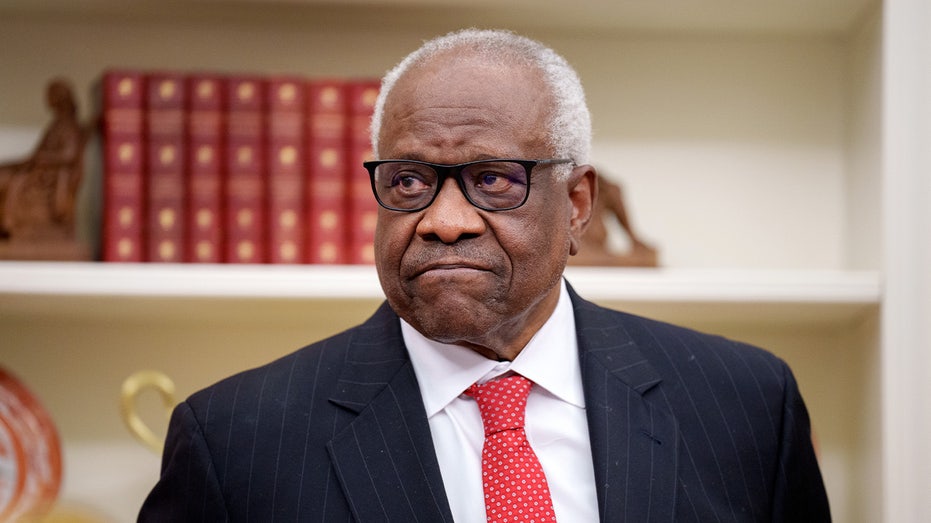
Supreme Court Justice Clasrence Thomas choked up recalling a promise he made after his grandparents’ deaths during a wide-ranging conversation about economist Thomas Sowell’s influence on his thinking and views on Black Americans.
“When both my grandparents died suddenly in 1983, the decision I made was to live the rest of my life as a memorial to theirs,” Thomas shared with Hoover Institution fellow Peter Robinson during an on-stage discussion.
The conversation paused for a few seconds as Thomas gathered his composure.
“And the point I’m going to make is that is the way I feel about Professor Sowell,” Thomas said.
JUSTICE THOMAS REVEALS THIS ELITE INSTITUTION IS ‘OFF LIMITS’ TO HIM “ ‘THAT’S THE WORLD WE’RE IN’
“All right,” Robinson said. “Watch this because I’m going to lighten the mood here.”
Thomas was raised by his maternal grandparents in segregated Savannah, Georgia, after his father left when he was 7 years old. His grandfather was raised by a freed slave.
“We actually lived — farmed on a part of that plantation, and we grew up every summer, we farmed on that plantation,” Thomas said.
Neither of Thomas’ maternal grandparents ever set foot in a high school. Thomas said his grandfather, Myers Anderson, had only nine months of formal education, and his grandmother, Christine Anderson, had only a sixth-grade education.
SEN TIM SCOTT: MY FAMILY’S JOURNEY SHOWS AMERICA’S FOUNDING PROMISE IS ALIVE AND STRONG
“Even though my grandfather only had nine months of education, the crown jewel was education. My grandmother went to the sixth grade, for her the crown jewel,” Thomas said.
Thomas described his grandmother as a “saintly woman” and his grandfather as a “great man” who taught him the importance of self-reliance and hard work.
“It wasn’t taking the measure of what you don’t have. It wasn’t to complain about that, but to develop the capacity to do things that you needed to do in order to… improve your life.”
“My grandfather, I remember him often saying, as a kid,” Thomas said, referring to his grandfather responding when Thomas complained about being unable to do something. “And his favorite saying was, ‘old man can’t is dead. I helped bury him.”
“And the old man can’t was buried many times in our house,” Thomas said.
“My grandfather, no education, raised by a freed slave, and he never complained,” Thomas stated. “He did it. He was a — he was just a great man. Now what do you do? How do you complain when he had nothing, no education? What do you say to it? But he sets this example of how you live your life.”
Thomas said rediscovering Sowell, who is also Black, gave him permission to think differently from Black leaders. He recognized Sowell’s message in his grandparents and the Catholic nuns who educated him.
SIGN UP TO GET THE POLITICS NEWSLETTER
“Well, I think it’s something that Professor Sowell has been trying to stress, that a lot of the groundwork to being able to do difficult things, to achieve, are attitudes. And he talks about other groups,” Thomas said. “And that’s what attracted me initially to Race and Economics, because if you go back and you look at Race and Economics, he talks about attitude of self-reliance, of self-discipline, etc., how important those were.”
“Where did I first hear that? I heard from my grandfather, the single greatest man I’ve ever known, my grandmother, a saintly woman, my nuns. Same thing. It’s the exact same thing,” Thomas continued.


