





Canadian Prime Minister Mark Carney said Friday he hopes to finalize an agreement by June establishing Canada as the European Union’s first “associate member.”
Carney announced the target date at the conclusion of a two-day Canada-EU summit in Montreal, where he joined European Commission President Ursula von der Leyen and European Council President Antonio Costa to launch a new partnership focused on trade, technology, defense, and energy.
“Our Alliance with the European Union is built on shared history, common values, and mutual respect,” Carney said. “They are the foundation on which we move ever closer together to give our citizens more choice, more opportunity, and a more affordable future. That is what sovereignty looks like: the freedom to live our lives as we choose, on our own terms. The ambition to build a better, more prosperous world for ourselves, for our children, and for our children’s children. Ours is an Alliance that delivers now and for the future.”
</p>
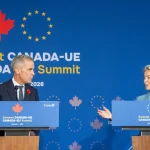
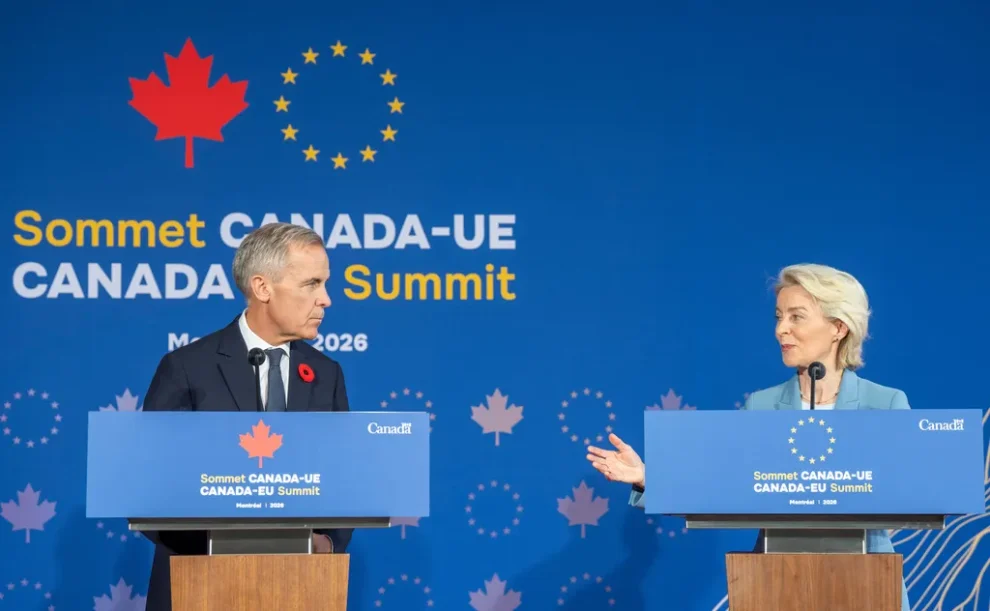
<p> ” data-large-file=”https://conservativemodern.com/wp-content/uploads/2026/10/carney-aims-for-june-deal-with-eu-to-define-associate-member-status-in-bid-to-undercut-us-influence.webp?w=1024″ src=”https://conservativemodern.com/wp-content/uploads/2026/10/carney-aims-for-june-deal-with-eu-to-define-associate-member-status-in-bid-to-undercut-us-influence.webp” alt=”EU-Canada Summit” class=”wp-image-4786901″ srcset=”https://conservativemodern.com/wp-content/uploads/2026/10/carney-aims-for-june-deal-with-eu-to-define-associate-member-status-in-bid-to-undercut-us-influence.webp 1024w, https://conservativemodern.com/wp-content/uploads/2026/10/carney-aims-for-june-deal-with-eu-to-define-associate-member-status-in-bid-to-undercut-us-influence.webp?resize=300,185 300w, https://conservativemodern.com/wp-content/uploads/2026/10/carney-aims-for-june-deal-with-eu-to-define-associate-member-status-in-bid-to-undercut-us-influence.webp?resize=768,474 768w” sizes=”(max-width: 1024px) 100vw, 1024px”><figcaption class=) European Commission President Ursula von der Leyen gestures toward Prime Minister Mark Carney during the closing press conference at the EU-Canada summit in Montreal on Friday, Oct. 30, 2026. (Christinne Muschi/The Canadian Press via AP)
The proposed arrangement would give Canada the closest possible relationship with the EU short of full membership. The two sides have yet to determine what associate membership would entail, with Carney saying negotiations over its “substance, scale and scope” will continue in the coming months. He plans to attend European Council meetings in June to work toward an agreement.
The effort comes as relations between Ottawa and Washington have deteriorated over President Donald Trump’s tariffs, trade demands, and repeated threats to make Canada the 51st state.
Carney pushed back against Trump’s remarks in January at the World Economic Forum, declaring that “Canada doesn’t live because of the United States” and that the country “thrives because we are Canadian.”
Von der Leyen first proposed making Canada the EU’s inaugural associate member in September. However, the designation has encountered resistance from some member states, including Germany. The joint declaration released Friday instead committed the partners to defining an “ever-closer association” by their 2027 summit without adopting the associate member title.
Beyond the membership negotiations, the leaders announced more than 20 initiatives under their new Alliance for the Future, which could eventually include other like-minded countries.
The agreements include a digital trade deal, expanded cooperation on critical minerals, and Canadian access to Europe’s JUPITER supercomputer. The partners will also explore a trans-Atlantic data cable and increased Canadian liquefied natural gas exports to Europe.
On defense, Canadian defense company Galvion secured a contract worth more than $44 million to supply military helmets to Latvia through the EU’s Security Action for Europe initiative.
WHAT TO KNOW ABOUT THE ALBERTA REFERENDUM ON LEAVING CANADA
The EU is Canada’s second-largest trading partner, with bilateral trade valued at approximately $178 billion in 2025. The United States, however, accounted for more than 70% of Canadian merchandise exports that year.
Carney has pledged to double Canada’s exports to markets outside the U.S. over the next decade.


