




Candidates jostling to succeed Gavin Newsom as the governor of California are being forced to walk a fine line between acknowledging voter frustration, while avoiding direct criticism of a man who could dominate national Democratic politics for the next decade.
Until proven otherwise, Newsom is seen by many as the presumptive front-runner for the 2028 Democratic presidential ticket. But under his stewardship, California has struggled with major challenges, including multibillion-dollar deficit, a deepening affordability crisis, and some of the highest gas and electricity costs in the country.
WHY TRUMP IS SO INTERESTED IN GREENLAND
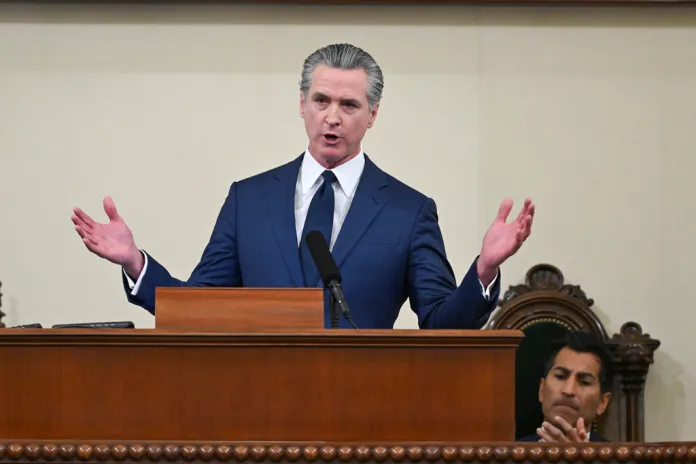
Newsom, who is term limited and will step down at the end of 2026, has long shown a talent for deflection, glossing over problems he helped create or exacerbate. But his record is a liability for Democrats who want to succeed him in Sacramento.
“Gavin Newsom paints a long political shadow for any Democrat who follows him,” Jeff Burton, founding partner at Maven Advocacy, told the Washington Examiner. Burton, a former senior National Republican Congressional Committee official, said California Democrats running for governor lack the “star” power to confront the state’s problems without fear of political backlash, which could help explain their silence.
He added: “Gov. Newsom’s name has rarely come up in the primary, among Democrats, because they are scared of not being left enough and/or ticking off Governor Newsom’s machine, which has now won four elections in overwhelming fashion – governor, recall, governor, and Proposition 50.”
Matthew Klink, partner at California Strategies, LLC, echoed the point.
“No Democrat will outright criticize Governor Newsom because of their desire to have him campaign on their behalf, and because they want to preserve a relationship with the governor should he decide to run for president in 2028,” he told the Washington Examiner. Klink added that candidates “must strike a balancing act between praising Governor Newsom for his eight years of service and keeping the nation’s biggest state top of mind” but must also offer new solutions to some of the state’s most persistent problems.
California is currently facing its fourth consecutive year of budget shortfalls, high housing costs (where the median home price is projected to reach $905,000 in 2026), and has the nation’s highest unemployment rate outside of Washington, D.C. Entire communities affected by last year’s devastating wildfires are only now in the early stages of rebuilding or offloading their lots altogether. There is also a financial fallout from last year’s federal “One Big Beautiful Bill.”
President Donald Trump’s bill included deep cuts to Medi-Cal, the state’s Medicaid program, leading Newsom to backpedal on a promise to provide state-level medical care to all residents. Other social safety net programs like CalFresh, the state’s food stamp program, are also taking a hit.
During his final State of the State address, Newsom touched on the rising cost of homes, but blamed corporate investors, whom he accused of “snatching” them up, “by the hundreds and thousands at a time.”
The governor also addressed homelessness, a large public safety concern in the state. Newsom claimed the number of unsheltered people on his watch had declined, but again blamed local officials for dragging their feet on other issues tied to the problem.
Homelessness has long been a political albatross for Newsom, haunting him not only during his tenure as governor but also as mayor of San Francisco.
Since 2019, the state has provided grants to local governments to control their homelessness crisis but despite spending billions of dollars on the problem, homelessness hasn’t improved as much as he had hoped. Two decades ago, Newsom, who was running for mayor, claimed, “I own this” crisis. That declaration has followed him ever since.
The race to replace
As it stands, 10 candidates are headed to the June 2 primary election. According to a November Berkeley IGS poll, 44% of surveyed voters didn’t have a preference for governor, and no candidate polled above 15%.
The field of contenders includes former U.S. Health and Human Services Secretary Xavier Becerra (D); former Rep. Katie Porter (D); billionaire Tom Steyer (D); former Riverside Sheriff Chad Bianco (R); former Los Angeles Mayor Antonio Villaraigosa (D); former state controller Betty Yee (D); California’s State Superintendent of Public Instruction Tony Thurmond (D); former state lawmaker Ian Calderon (D); and former Fox News host Steve Hilton (R). California’s jungle primary sees the top two finishers square off against each other in the November election.
Unsurprisingly, Hilton and Bianco have consistently hit Newsom on his governing failures. The few criticisms from Democrats have been mild and issue-specific. Villaraigosa, for example, has criticized Newsom for his decision to keep children out of school for an extended period during the pandemic. Yee has said she’d focus on better fiscal accountability.
Steyer has offered some criticism of Newsom’s handling of the state’s past budget surpluses, while Calderon took an indirect jab at the governor’s White House goals, saying state leaders should focus on state issues rather than national politics.
Becerra has called out the state’s high-speed rail project, which has been viewed as a master class in mismanagement. He’s also pointed to the housing crisis, healthcare, and budget cuts. Becerra and Newsom have been tangled in a 2025 federal corruption investigation that has caused some tension between the former allies. Newsom’s former chief of staff, Dana Williamson, was indicted for allegedly conspiring to steal $225,000 from a dormant campaign account belonging to Becerra.
When it comes to Newsom’s own political ambitions, experts warn the governor could be his own worst enemy when he unveils his final budget in May. Newsom claimed there was only a $2.9 billion defecit but the state legislature’s budget advisor, Gabe Petek, projected another $18 billion deficit for 2026-27, perhaps growing to $35 billion thereafter.
What does help Newsom is his ability to position himself as the counterweight to the Trump administration.
A recent poll from the Public Policy Institute of California found that the governor’s approval rating jump edafter he helped get Proposition 50, a redistricting measure, over the finish line. Another poll by Overton Insights of 1,200 registered voters has Newsom leading Vice President J.D. Vance by three percentage points in an early potential head-to-head matchup for president in 2028.
COURT RULES CALIFORNIA CAN USE NEW DEMOCRATIC-FAVORED CONGRESSIONAL MAP
Garry South, a California political strategist who helped run Newsom’s first campaign for governor, told the Washington Examiner that Newsom, like every other governor who has run for president, will have to account for his record.
“In every case, there were pluses and minuses, successes and failures,” he said. “American voters appreciate the qualification of having actual governing experience before someone takes the reins of the most powerful country in the world.
Newsom’s team was asked to provide comment multiple times by the Washington Examiner, but at time of print, declined to do so.


