






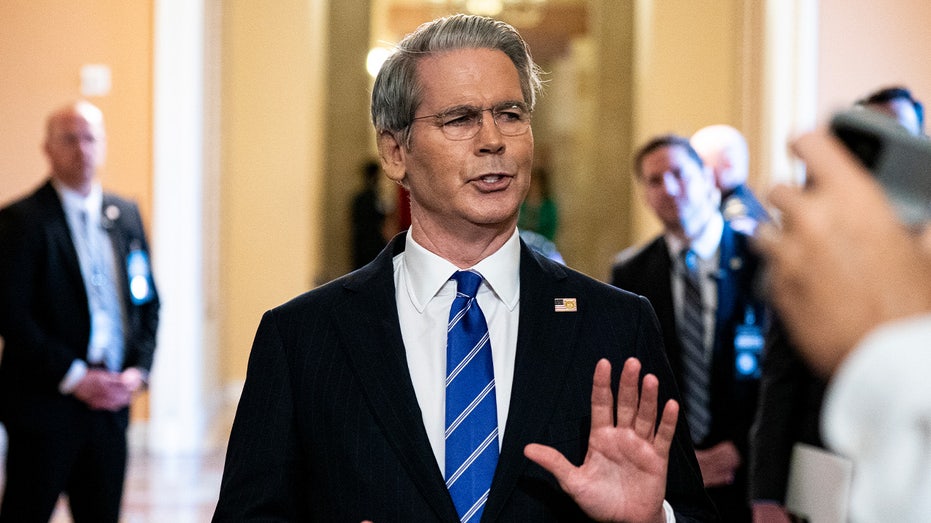
Treasury Secretary Scott Bessent suggested Tuesday that President Donald Trump’s tariffs could be restored as early as July, signaling a rapid pivot by the Trump administration after the Supreme Court struck down Trump’s IEEPA-based tariffs earlier this year, forcing the administration to turn to other trade authorities.
“We had a setback at the Supreme Court in terms of the tariff policy,” Bessent said Tuesday at an event hosted by the Wall Street Journal. “But we will be implementing or conducting Section 301 studies — so the tariffs could be back in place at the previous level by [the] beginning of July.”
His remarks come after the Supreme Court ruled in February that the International Emergency Economic Powers Act, or IEEPA, does not authorize tariffs.
Trump has billed tariffs as “life or death” for the U.S. economy — underscoring the outsize importance the administration has placed on the issue.
TRUMP TARIFF PLAN FACES UNCERTAIN FUTURE AS COURT BATTLES INTENSIFY
Bessent’s comments also come as the U.S. collected more than $133 billion in IEEPA tariff duties as of mid-December, according to data published by the U.S. Customs and Border Protection agency, a figure that later grew to roughly $166 billion by early March 2026.
The administration moved to preserve tariffs in the weeks since the Supreme Court’s ruling to find new ways to implement the import fees, invoking several provisions of the U.S. Trade Act of 1974 in order to do so.
Bessent’s remarks, first reported by Bloomberg, are a sign that the Trump administration plans to enact a combination of statutes under the trade law as it looks to move past the high court’s ruling and find new ways to sustain U.S. tariff pressure.
The strategy, long-term, appears to focus largely on Section 301 of the Trade Act of 1974, which allows the president and the U.S. Trade Representative’s office (USTR) to implement “retaliatory import restrictions” against a country that is found to have engaged in unfair or “discriminatory” trade policies or practices towards U.S. businesses.
Section 301 allows the U.S. Trade Representative to investigate and respond to “unfair” foreign trade practices flagged by the president, though they require a formal period of notice and public comment, delaying enforcement.
Since the Supreme Court’s ruling, the Trump administration has initiated a flurry of more than 75 investigations under Section 301, according to a report from Alan Wm. Wolff, a senior fellow for the Peterson Institute for International Economics — far outpacing the average annual number of Section 301 investigations initiated during the past five decades.
TRUMP WARNS SUPREME COURT TARIFF SHOWDOWN IS ‘LIFE OR DEATH’ FOR AMERICA
That’s not the only lever administration officials have pulled in an effort to keep Trump’s tariffs in place, however.
Trump last month announced new 10% global tariffs — an emergency provision under the trade law that allows a president to unilaterally impose import fees of up to 15% on U.S. trading partners for a period of 150 days, to respond to large and serious “balance of payments deficits,” or instances that risk immediately depreciating the power of the dollar.
The Section 122 announcement prompted a lawsuit from 24 attorneys general, who argued the move was an illegal attempt to “sidestep” the Supreme Court’s ruling. It also prompted another lengthy hearing before the U.S. Court of International Trade in Manhattan Friday, as judges on the three-member panel weighed the legality of Trump’s effort.
Lawyers for the challenges told the court Friday that upholding the administration’s broader view of the law would effectively turn Section 122 into an all-purpose trade weapon.
US COURT OF INTERNATIONAL TRADE SIDES WITH TRUMP IN TARIFF CASE
But Justice Department lawyer Brett Shumate argued that Congress had provided presidents with broad discretion to assess economic conditions.
“A trade deficit was a large driver of a balance of payments deficit in 1974 as it is today,” Shumate said.
“We’re not on the gold standard anymore,” he said. “We don’t have a fixed currency, but we can still have balance-of-payment problems.”


