





A new national defense survey shows Americans are increasingly alarmed by global threats and more willing to see the United States assert leadership on the world stage — even as doubts grow about the military’s readiness to deter adversaries and win wars overseas.
The 2025 Reagan National Defense Survey, released Wednesday by the Ronald Reagan Institute, finds 64% of Americans want the U.S. to be more engaged and take the lead internationally, a clear majority that cuts across political lines. But that desire for greater U.S. leadership comes alongside a darker view of the Pentagon’s capabilities: just 49% believe the U.S. military can win a war overseas, and only 45% say it can effectively deter foreign aggression.
In an interview, Rachel Hoff, policy director at the Reagan Institute and one of the survey’s authors, said the public’s desire for U.S. global involvement has held steady over the years — but their expectations shift as questions become more specific.
“The American people really do support an engaged American presence on the international stage,” Hoff said. At the same time, she noted, the public believes the U.S. “[has] the most powerful military in the world” and that American superiority “ultimately leads to a more peaceful and secure world.”
TAIWAN FM HAILS IMPORTANCE OF US RELATIONSHIP, SAYS GROUP VISITS ‘CONTRIBUTE TO PEACE AND STABILITY’
The survey’s findings underscore an ongoing tension in public opinion: Americans want the U.S. to lead, but they also see a military struggling to maintain an edge over rising authoritarian adversaries.
One of the most notable long-term trends in the survey is the decline in trust in the armed forces. Only 49% of Americans now say they have “a great deal” of confidence in the military — down 21 points since 2018.
SENATE MOVES TO REIN IN TRUMP ADMINISTRATION’S FLUCTUATING UKRAINE POLICY
Hoff said the downturn is broad-based.
“It’s happened among Americans of all political stripes, both men and women, people of different age demographics,” she said. Though the numbers appear to have stabilized in the last two years, the shift marks one of the most significant drops in confidence for any major public institution.
When asked what Americans attribute this erosion to, Hoff said the survey consistently highlights one theme.
“It all has to do with something around kind of the politicization of the military,” she said. “The American people really want to keep politics out of the military and keep the military focused on its core warfighting mission.”
Another major finding: support for sending U.S. weapons to Ukraine has risen to 64%, up nine points since last year. Roughly two-thirds of Americans also say they want Ukraine to win the war. And 45% support backing Kyiv until it regains all Russian-occupied territory.
Hoff said the shift reflects a renewed focus on Ukraine’s fate — and a notable change among Republican voters.
“There’s been a real increase in support for sending U.S. weapons to Ukraine,” she said, adding that it has been “particularly notable among Republicans.”
She pointed to the political environment under President Trump.
“With Donald Trump back in the White House with his administration leading on peace talks between the Russians and the Ukrainians, we’re seeing not just a desire for America to be in a peace-building role, but in fact for Ukraine to emerge as victorious,” she said.
While fewer Americans support fighting until full territorial sovereignty is restored, 45%, Hoff said that nuance doesn’t alter the core view: the public sees Ukraine as a friend and Russia as an adversary.
“They want to see peace in the region … they perceive Ukraine as an ally, they perceive Russia as an adversary,” she said.
The survey shows a dramatic surge in public backing for defending Taiwan. Sixty percent of Americans now say they would support committing U.S. forces to Taiwan’s defense if China invaded — up from 48% last year.
Nearly every potential U.S. response the survey tested — including sanctions, moving military assets, sending equipment, and establishing a no-fly zone — rose by around ten points.
Hoff said the reason is clear: Americans increasingly view China as the United States’ primary strategic threat.
“Almost every response to a potential Chinese invasion of Taiwan that we poll test … has gone up around 10 points just in the last year,” she said. “The American people are really clear-eyed about who our friends are and who our adversaries are.”
This year’s survey again shows China as the top perceived threat to the U.S., far ahead of Russia, Iran, or North Korea. Rising concern about Beijing’s military power, cyber capabilities, and global influence appears to be driving the growing support for defending Taiwan.
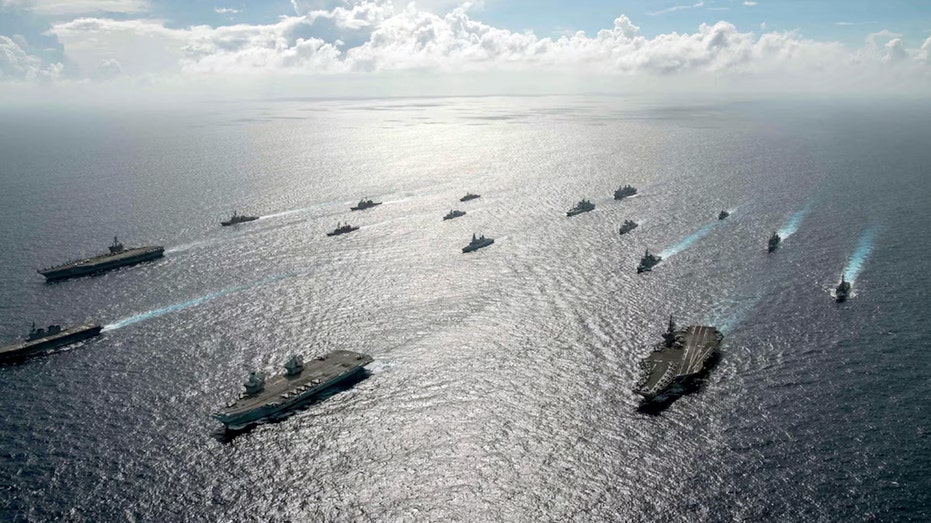
The survey comes as the Pentagon reevaluates its defense strategy and the resources required to counter China and Russia. Hoff said the data provide a straightforward message: the public expects leadership and credible strength.
“The American people see the threats around the world, they understand who our friends and adversaries are, they want the U.S. to lead globally and to stand up in defense of freedom,” she said. “They want an American military that’s resourced and postured to do so.”
Asked what the Pentagon should take from the findings, Hoff said defense leaders can be confident that the public supports a robust American presence worldwide.
“Americans really want the U.S. to be engaged, to be supporting our allies and partners,” she said. And they want a military “poised to balance American interests and advance American interests across each of these regions … to restore deterrence and restore peace.”


