







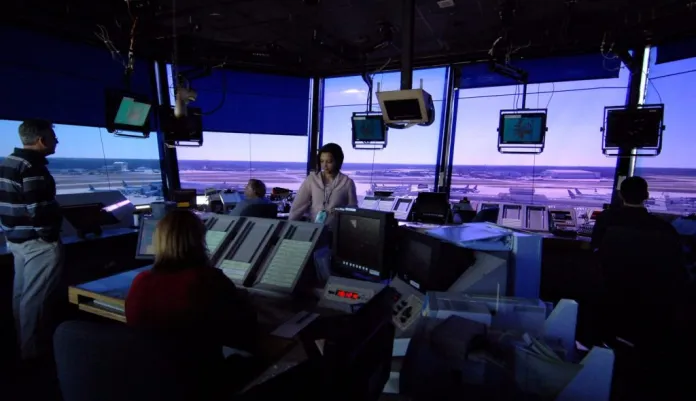
EXCLUSIVE — Air traffic controllers are accusing the Department of Transportation and Federal Aviation Administration of prioritizing efficiency and cost-cutting over public safety, a shift that workers warn has driven morale to an all-time low and placed the flying public at heightened risk.
Air traffic controllers shared those dynamics following an August interview with FAA Administrator Bryan Bedford published by the Washington Examiner. More than 400 individuals who identify as FAA air traffic controllers have privately reached out to the publication since then and warned that the nation’s aviation system has reached a breaking point.
These mounting problems have placed immense pressure on an exhausted, underpaid, and mentally stressed workforce expected to perform flawlessly every time they sit at the controls. The crisis has led to tragic and unprecedented outcomes: insiders note that suicides among controllers are eight times the national average, while tenured employees are increasingly walking away from the agency years before reaching mandatory retirement age.
 Law enforcement authorities have charged two men in relation to an incident in which an air traffic controller at Charlotte Douglas International Airport in North Carolina allegedly had possession of weapons of mass destruction. (AP Photo/The Charlotte Observer, Todd Sumlin)
“We work hard every day and take a tremendous amount of pride in what we do,” one controller wrote in a text message. “Most of us are veterans. We have been completely demoralized for the past 5 years while trying to manage the busiest airspace in the world with more airplanes than any other time in aviation.”
Backlash over FAA administrator’s capitalist approach
Rank-and-file workers argue that Bedford is approaching agency management entirely backward, treating a federal safety agency like a corporate balance sheet by trying to squeeze out every ounce of productivity from controllers. Critics say he is running the FAA like a capitalist businessman, prioritizing cost-effectiveness as he did at his former company, regional Republic Airways, while treating public safety as a secondary concern.
One controller from the New York Center who retired in August said he chose to leave after more than two decades due to the deteriorating culture.
“With the administration that’s in now, the morale in that building is at an all-time low,” he said, speaking on the condition of anonymity.
The retired controller stated that management at his facility focused heavily on keeping controllers on shift longer, a move he says actively endangers the public.
What upset the workforce most, however, was Bedford’s admission that the FAA is withholding a 2.8% retroactive raise, and wrongly claiming it was a union issue and not under the FAA’s control, which the Washington Examiner investigated last month. Although Congress approved and funded the compensation package four months ago, Bedford said it is on hold until the agency can “unlock more productivity” from its workers by having them work five hours at the controls each shift instead of the current four.
“Controllers are working harder than ever, moving more traffic than ever, and are responsible for a large portion of the country’s GDP but Bedford and [Transportation Secretary Sean Duffy] are literally trying to make [the] job more difficult instead of helping us,” another controller wrote in a message.
Hanan Wiseman, the Boston Consolidated TRACON (A90) Facility Representative and a member of the Northern New England Regional Labor Relations team, issued a letter addressing Bedford’s stance.
“Congress put the raise money in the law in April and left the decision to pay it in the Administrator’s ‘sole discretion.’ The law does not require a single thing from this union,” Wiseman wrote. “He could sign the determination today. The condition he described on camera is one he invented. That is gaslighting, plain and simple. We do not decide whether a facility is open 24 hours. We do not manage scheduling. We do not assign the work. Every one of those is an Agency function, and if the Administrator believes they are broken, he sits in the perfect position to fix them.”
</p>
<p> ” data-large-file=”https://conservativemodern.com/wp-content/uploads/2026/09/air-traffic-controllers-turn-on-faa-chief-as-tensions-boil-over-1.webp” src=”https://conservativemodern.com/wp-content/uploads/2026/09/air-traffic-controllers-turn-on-faa-chief-as-tensions-boil-over-1.webp” alt=”Federal Aviation Administration administrator Bryan Bedford looks on as Transportation Secretary Sean Duffy speaks during a news conference with the FAA seal on the wall behind him.” class=”wp-image-4699004″ style=”aspect-ratio:1.4967908867905508;width:445px;height:auto” srcset=”https://conservativemodern.com/wp-content/uploads/2026/09/air-traffic-controllers-turn-on-faa-chief-as-tensions-boil-over-6.webp 1024w, https://conservativemodern.com/wp-content/uploads/2026/09/air-traffic-controllers-turn-on-faa-chief-as-tensions-boil-over-6.webp?resize=300,201 300w, https://conservativemodern.com/wp-content/uploads/2026/09/air-traffic-controllers-turn-on-faa-chief-as-tensions-boil-over-6.webp?resize=768,514 768w, https://conservativemodern.com/wp-content/uploads/2026/09/air-traffic-controllers-turn-on-faa-chief-as-tensions-boil-over-6.webp?resize=150,100 150w, https://conservativemodern.com/wp-content/uploads/2026/09/air-traffic-controllers-turn-on-faa-chief-as-tensions-boil-over-6.webp?resize=696,466 696w” sizes=”auto, (max-width: 1024px) 100vw, 1024px”><figcaption class=) Federal Aviation Administration Administrator Bryan Bedford looks on as Transportation Secretary Sean Duffy speaks during a news conference on new drone regulations, Aug. 5, 2025, at the Department of Transportation in Washington. (AP Photo/Julia Demaree Nikhinson)
Federal Aviation Administration Administrator Bryan Bedford looks on as Transportation Secretary Sean Duffy speaks during a news conference on new drone regulations, Aug. 5, 2025, at the Department of Transportation in Washington. (AP Photo/Julia Demaree Nikhinson)The FAA requires controllers to teach trainees, as well as learn new technology, new procedures, and changes in airspace when not at the controls. Controllers must participate in team briefings and weather briefings. They work, then have recuperative breaks.
The toll of chronic understaffing
The push for productivity stands in contrast with how safety is measured. The National Transportation Safety Board told Congress in February that “research in a simulated air traffic control room showed that extended time on task (over 90 minutes) increased detection latency for complex events such as two aircraft at the same altitude on the same flight path.”
This means every additional minute a controller is forced to work beyond that window drastically increases the likelihood of a catastrophic miscall, making sheer productivity a potentially dangerous metric for success.
Additionally, air travel has surged since 1980. More than 906 million people boarded flights in the United States last year compared to 295 million in 1980, yet thousands fewer certified controllers work today than 46 years ago — about 11,000 now compared to 16,300 then.
Controllers are buckling under the scheduling requirements. Every controller who spoke with the Washington Examiner, alongside more than 100 who sent private messages, reported a long-term trend of getting just four days off per month. Shifts regularly span 10 hours. Instead of working a standard four-day, 40-hour week, controllers are assigned two mandatory overtime shifts per week, forcing them into six-day workweeks that often devastate family and personal life, as well as complicate mental health.
The back-to-back shifts can also hurt sleep cycles. Rather than working stable hours, controllers cycle through chaotic shifts, often working an overnight block and returning to the facility just 10 hours later, only for the following day’s shift to start at a different time of day or night.
 An airplane flies over an air traffic control tower at LAX in California. (stellalevi/Getty Images/iStock)
Amid this operational fatigue, a recent leak has further strained relations between staff and leadership. Days after Bedford’s interview, internal FAA findings were leaked to the Wall Street Journal, painting controllers in a negative light by suggesting that two at LaGuardia Airport had recklessly walked off their jobs early.
Insiders, including retired air traffic controller Dave Riley, argue the leak mischaracterized standard facility practices designed to address worker fatigue, such as the “59-minute rule,” which permits controllers to leave within an hour of their shift’s end if there is adequate coverage.
“I bet you the two controllers that went home early were probably working their butts off all night,” Riley said in a phone call. “When the mid-shift guys got there, they recognized that and were like, ‘Hey, you guys get out of here, we’re going to cover this.’ Those controllers probably had minimum time off before their next shift—nine or 10 hours—where they had to rush home just to maybe get six or seven hours of sleep. That’s the fatigue that controllers have been going through.”
More than 90% of the nation’s 313 air traffic control facilities were short-staffed as of 2025, according to the New York Times. Staffing shortfalls, created when employees choose to retire early and most trainees fail out, are a leading factor for flight delays, not employees taking sick days, as Duffy has publicly stated. Towers can only manage so many flights at a time with the limited number of staff available.
John Scully, a 30-year air traffic controller who worked at FAA headquarters in Washington for a decade, said the DOT and FAA have continued to “devalue” controllers “with public tweets about sick leave abuse.”
Data on suicide among air traffic controllers show that in 2024, controllers were eight times more likely to die by suicide than the national average, with 12 deaths reported in that calendar year, according to information obtained through a Freedom of Information Act request and shared with the Washington Examiner.
“You can tell Bedford to contact us,” another controller wrote. “We have a list of growing suicides. Since he’s so blissfully ignorant.”
Short workers and short in pay
The union and the FAA agreed several years ago to address staffing by hiring enough trainees that in several years’ time, the FAA would have 14,500 certified controllers, but Duffy and Bedford adjusted those levels down by 2,000 controllers. Duffy and Bedford declared there was no staffing shortage because they had simply reduced the number of controllers needed.
In the next few years, staffing is set to go off the cliff. The FAA’s own projections show 6,900 of its current 11,000 certified controllers will retire by 2028.
A Government Accountability Office study released in January concluded that just 2% of applicants of applicants will become certified controllers, making it impossible to make up for the massive personnel loss ahead.
Hiring was halted during the pandemic because trainees were unable to attend classes due to social distancing, which exacerbated the staffing shortfalls. Last year, the FAA convinced Congress to fund a $12.5 billion overhaul of systems and infrastructure of the air traffic control system, including some money for hiring.
 Transportation Secretary Sean Duffy announces a new air traffic control infrastructure plan, Thursday, May 8, 2025, in Washington. (AP Photo/Julia Demaree Nikhinson)
“Nobody cares about the new equipment,” the retired New York controller said.
Meanwhile, Riley said controller salaries remain dramatically behind 2026 levels, adjusted for a decade of inflation into account.
The FAA’s hiring page touts “elite compensation” with the “average certified earnings [exceeding] $155,000+ per year within 3 years of Academy graduation.”
Those salaries are based on location and traffic. Some controllers volunteered their salaries to the Washington Examiner and reported making around $100,000 per year, even after a decade of experience.
“We have 5,000 lives our in hands at a time or a shift,” Riley said. “And we’re making like maybe [a] fifth, maybe [a] third, of what a pilot is making.”
A union but no voice
Controllers say they have stayed silent for fear of what could happen if they speak up or consider striking.
In 1981, more than 10,000 union members of the Professional Air Traffic Controllers Organization organized a strike. Former President Ronald Reagan made the unprecedented decision to fire 90% of unionized air traffic controllers for not returning to work within 48 hours and to permanently replace them with military air traffic controllers.
The Reagan administration shuttered PATCO, and air traffic controllers organized under a new union, the National Air Traffic Controllers Association.
Today, many controllers are as angry with the union as they are with the FAA and DOT.
“Through all of it, our President and the National Executive Board have sat silent,” Wiseman wrote. “They have turned their backs on us in the most critical of times and left us carrying the stress that the DOT and the FAA have placed on this workforce. That stress is the greatest threat to the safety of the flying public, and the world needs to know it.”
Several current and retired controllers suggested that NATCA and its president, Nick Daniels, were treading lightly with the Trump administration out of concern the government could legally decertify the union, as the Reagan administration did.
“The problem with that, in my opinion, at this point, is that these controllers been suffering for so long, not getting a contractual pay raise in the paybands since 2009, the pay has not kept up with inflation, and then everything is exacerbated by the overuse of overtime,” Riley said.
The union provided a comment from Daniels that stated “controllers have legitimate concerns about staffing, compensation, workload, and mental health [and] continue to perform an incredibly demanding job professionally.”
Daniels, who was elected as union president in 2024, said “a lot of work happens outside the public eye,” adding that NATCA was “engaging” with the DOT, FAA, and Congress.
“We listen, we acknowledge the concerns, and we advocate for solutions,” Daniels said. “Our responsibility is to turn those concerns into action while being realistic about what we can accomplish immediately and what will take time. We are actively working on compensation, staffing, scheduling, workload, and mental health issues. Some discussions are ongoing and involve multiple stakeholders, so we aren’t able to publicly discuss every detail.”
Capitol Hill takes notice
The crisis has caught the attention of lawmakers on Capitol Hill. After reviewing more than 100 comments submitted to the Washington Examiner by active controllers, Senate Democratic Whip Dick Durbin (D-IL) said Duffy should address the matter.
“Air traffic controllers already have one of the most stressful jobs in the country, and new, harrowing reporting shows they are being pushed to the brink by this administration as they work endlessly to ensure millions of people safely get to their destination,” Durbin said in a statement to the Washington Examiner.
Durbin, a longtime advocate of air traffic controllers, alleged that the administration is weaponizing well-deserved compensation adjustments against an exhausted workforce.
“Reporting shows that their pay increase is being used as a bargaining chip by the Trump administration, they work significant overtime hours, they have to request off a year in advance, they are not receiving access to mental health resources, and the list goes on,” Durbin said.
“Instead of focusing on his ridiculous reality TV show, the Secretary of Transportation should be prioritizing protecting the men and women who are working around the clock to keep our skies safe,” Durbin said.
 “Here’s what it boils down to: The presumption, I believe, should be in favor of keeping guns out of a person’s hand if they’re on the list,” Senate Minority Whip Dick Durbin told the Examiner. (AP Photo)
The FAA and DOT did not respond to requests for comment.
Scully, the FAA headquarters and air traffic controller veteran, said he believed the FAA did not respond “because they don’t have any good answers.
“I think the end game is the same as it has been for a long time: plausible deniability,” Scully said.
FAA LEAVES AIR TRAFFIC CONTROLLER RAISES IN LIMBO AMID MOUNTING STRAIN ON SYSTEM
A White House spokesman pointed to the FAA and DOT’s hiring ploy.
“There is no higher priority for President Trump than the safety and security of Americans, and Secretary Duffy has been personally leading the Department of Transportation’s effort to recruit new air traffic controllers and modernize America’s air traffic control system,” White House spokesman Kush Desai wrote in an email. “More controllers and a modernized control system will not only provide relief for these workers, but keep Americans safer in the skies.”


