




The American Israel Public Affairs Committee spent more than $30 million trying to keep Michigan’s Democratic Senate candidate Abdul el Sayed off the November ballot. It failed.
Now the pro-Israel group is back and spending nearly $95,000 to attack him in the general election, giving el Sayed a new opportunity to make his Republican opponent’s association a campaign issue.
The United Democracy Project, AIPAC’s super PAC, disclosed the new spending on direct-mail advertisements in a Friday filing with the Federal Election Commission. The mailers target 130,000 Jewish voters in Michigan, according to group spokesman Patrick Dorton, and revive a controversy over el Sayed’s response to a March attack on Temple Israel in West Bloomfield.
</p>
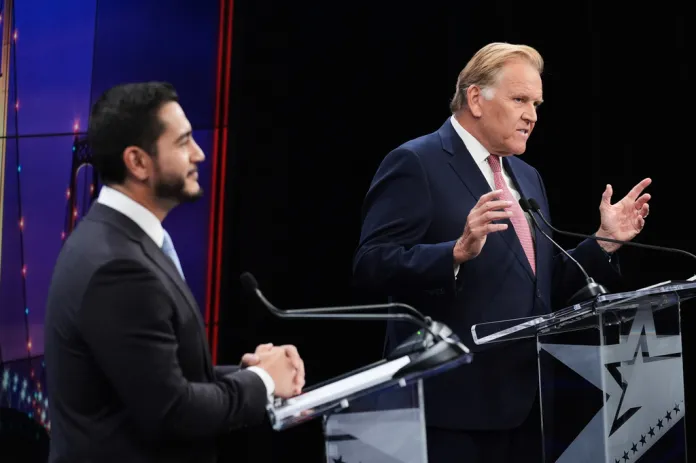
<p> ” data-large-file=”https://conservativemodern.com/wp-content/uploads/2026/10/aipac-takes-another-shot-at-el-sayed-and-hands-rogers-a-political-gamble-in-michigan-senate-race.webp” src=”https://conservativemodern.com/wp-content/uploads/2026/10/aipac-takes-another-shot-at-el-sayed-and-hands-rogers-a-political-gamble-in-michigan-senate-race.webp” alt=”Republican nominee for U.S. Senate Mike Rogers, right, speaks during a televised debate with Democratic opponent Abdul el Sayed.” class=”wp-image-4763124″ srcset=”https://conservativemodern.com/wp-content/uploads/2026/10/aipac-takes-another-shot-at-el-sayed-and-hands-rogers-a-political-gamble-in-michigan-senate-race-1.webp 1024w, https://conservativemodern.com/wp-content/uploads/2026/10/aipac-takes-another-shot-at-el-sayed-and-hands-rogers-a-political-gamble-in-michigan-senate-race-1.webp?resize=300,200 300w, https://conservativemodern.com/wp-content/uploads/2026/10/aipac-takes-another-shot-at-el-sayed-and-hands-rogers-a-political-gamble-in-michigan-senate-race-1.webp?resize=768,512 768w, https://conservativemodern.com/wp-content/uploads/2026/10/aipac-takes-another-shot-at-el-sayed-and-hands-rogers-a-political-gamble-in-michigan-senate-race-1.webp?resize=150,100 150w, https://conservativemodern.com/wp-content/uploads/2026/10/aipac-takes-another-shot-at-el-sayed-and-hands-rogers-a-political-gamble-in-michigan-senate-race-1.webp?resize=696,464 696w” sizes=”(max-width: 1024px) 100vw, 1024px”><figcaption class=) Republican nominee for U.S. Senate Mike Rogers, right, speaks during a televised debate with Democratic opponent Abdul el Sayed, at WOOD-TV, on Thursday, Oct. 8, 2026, in Grand Rapids, Michigan. (Paul Sancya/AP Photo, Pool)
Republican nominee for U.S. Senate Mike Rogers, right, speaks during a televised debate with Democratic opponent Abdul el Sayed, at WOOD-TV, on Thursday, Oct. 8, 2026, in Grand Rapids, Michigan. (Paul Sancya/AP Photo, Pool)The money comes with less than a month until Election Day and after weeks of reported tension between AIPAC and allies of GOP Senate candidate Mike Rogers, who feared the group’s involvement could backfire and ultimately strengthen el Sayed’s campaign.
Rogers, who is trailing in the polls, has now publicly welcomed the support. El Sayed is eager to hold him accountable.
“You know Mike Rogers is in trouble when he begs AIPAC to start spending against me,” el Sayed wrote on X. “Why do they hate me? Because I want to keep your tax money here to spend on your kids rather than spend it to kill kids somewhere else.”
Speaking to reporters at a campaign stop on Friday, Rogers dismissed concerns about UDP’s mailer spending and accused el Sayed of antisemitism.
“He is so anti-Jewish that one mail piece sends him into orbit,” Rogers said.
The mailers focus on el Sayed’s comment that “Hurt people hurt people,” made while discussing the Temple Israel attack, which the FBI described as a “Hezbollah-inspired act of terrorism.” The remark triggered criticism, prompting el Sayed to apologize in late August.
He said his words “may have been misconstrued to justify something I did not mean to justify.”
The controversy offers Rogers and his allies a way to keep el Sayed on the defensive over terrorism and his positions on Israel. But it also gives el Sayed another opening to argue that powerful outside interests are trying to influence Michigan’s Senate race.
That fight has already played out once, with AIPAC on the losing side.
UDP spent more than $30 million opposing el Sayed and supporting Rep. Haley Stevens (D-MI) in the Democratic primary. Stevens, a staunch supporter of Israel, lost to el Sayed by roughly 1 percentage point despite the financial advantage.
Rogers signaled during last week’s contentious televised debate that he was ready to accept AIPAC’s help, despite earlier reports that people close to his campaign had urged the group to stay out.
“Anybody that wants to help my campaign stop a guy who can’t condemn terrorism in our own country because he’s so close to the people who are supporting the Muslim Brotherhood, again, I’ll take all of that help,” Rogers said.
El Sayed cut in, “Again, I’ve condemned [the Muslim Brotherhood].”
The exchange exposed the strategy at the heart of the race. Rogers is trying to make el Sayed’s views on terrorism and Israel a liability. El Sayed is pushing back against attempts to portray his criticism of Israel as an unwillingness to condemn violence.
During the debate, the candidates clashed again over U.S. military assistance to Israel. Asked whether he would support funding for defensive weapons if Israel were attacked, el Sayed said he did not want American tax dollars buying weapons for other countries.
“I don’t know what’s so hard about that,” he said.
He also refused to choose whether Iran or Israel posed the greater threat to the United States, calling the question “a ridiculous hypothetical.”
For AIPAC, the new mailers are a relatively modest investment compared with the millions it deployed during the primary. The decision to intervene is politically significant for a group that has long sought to wield influence across party lines and is facing mounting criticism over its staunch support for Israel during the war in Gaza.
Its influence has become a complicated calculation even for some Republicans, who worry that publicly associating with the group could alienate voters opposed to its role in American politics.
OBAMA BACKS ABDUL EL SAYED IN NEW MICHIGAN SENATE AD
That concern reportedly surfaced in Rogers’s own orbit after the primary. Allies of the Republican nominee worried that AIPAC’s involvement could give el Sayed a potent political foil, allowing him to turn an attack over Israel into a broader argument about outside money and political influence.
Rogers has since made clear he is willing to accept the help. The new spending shows AIPAC is willing to provide it. The group’s financial firepower has never been in question. Whether it can change a race’s trajectory after failing to stop el Sayed in the primary is a different matter.


