





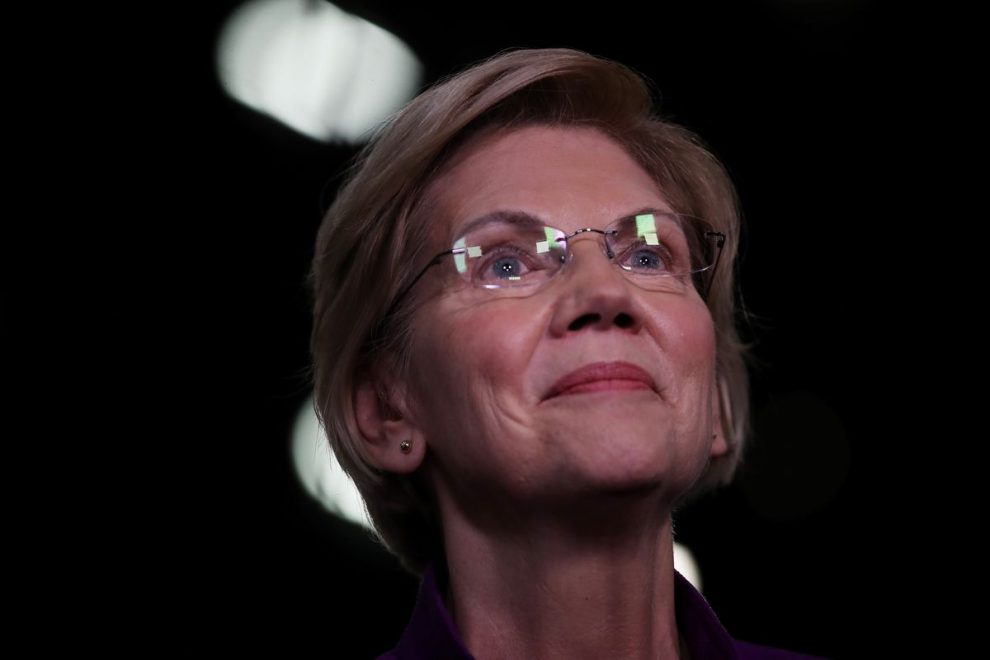
Elizabeth Warren famously has a plan for everything—everything, that is, except financing the single-payer health care system she says she supports. It’s a telling omission that reveals what happens when Warren’s wonky tendencies come into conflict with her campaign mantras.
Since launching her presidential campaign, the Massachusetts Democrat has rolled out Warren-branded plans for everything from universal childcare to green energy to “economic patriotism.” But on health care, so far, the senator has been content to endorse Bernie Sanders’ Medicare for All plan, which would eliminate most private health insurance and set up a government-run health insurance system, without putting forth one of her own.
The Sanders plan would, according to Sanders himself as well as multiple independent estimates, require new government spending totaling somewhere between $30 and $40 trillion a year. While Sanders has outlined ways to offset some of that cost, he hasn’t put forth a plan to fully finance the additional spending. He has, however, made clear that it would require higher taxes on the middle class.
Halima Salman convicted of receiving ISIS military training in Syria, faces 10 years in prison
Harley-Davidson’s Decade-Long Electric Motorcycle Initiative Has Turned Disastrous
Rock Legend Donnie Iris Dies Less Than Three Weeks After Retiring from Performing
Federal officials identify 400 noncitizens registered to vote in Washington state: ‘Tip of the iceberg’
Cassidy Hutchinson avoids indictment after DOJ effort to charge her over Jan 6 testimony fails: sources
NYC Mocked as Mamdani Builds New ‘Sidewalk Sheds’ That Drain Water Toward Buildings, So Expensive City Refuses to Give Price Tag
Man accused of threatening to hijack United flight says it was a drunken joke
Report Claims Hegseth Has Asked GOP Candidate for Governor to Appoint Him to Senate Seat
Rep Tom Tiffany claims Kamala Harris’ visit signals weakness in David Crowley’s Wisconsin campaign
Russian diesel tankers close in on US ports as Trump, Putin deal triggers legal showdown
Watch: Outrageous Pro-El-Sayed Ad Blames Jewish State for Raising Price of Bananas, Eggs in Michigan
Haitian illegal immigrant charged in Walmart killing entered US via Biden parole program: DHS
Flavio Bolsonaro to be issued visa by State Department after fleeing Brazil
Right-Wing Presidential Candidate Flavio Bolsonaro Secretly Flees Brazil for US After Disputed Election: Report
Luxury real estate brothers sentenced to 30 years in prison for yearslong sex-trafficking scheme
But despite endorsing Sanders’ plan, Warren has repeatedly declined to say that middle-class taxes would have to go up. She dodged the question in earlier debates this year. And at the debate last night, she once again all but refused to answer the question directly.
Instead, she offered a vague promise that “middle-class families are going to pay less” while insisting that “those at the very top—the richest individuals and the biggest corporations—are going to pay more.”
When a debate moderator pressed her specifically on the question of taxes, she still declined to offer a direct response. Families have to deal with “total cost,” she said, reiterating her support for Medicare for All. “Costs are going to go up for wealthier individuals, and costs are going to go up for giant corporations. But for hard-working families across this country, costs are going to go down, and that’s how it should work under Medicare for All in our health care system.” The specific question—Would taxes rise for middle-class families?—remained unanswered.
In part, this is a sign that Warren, though running what is nominally a bold progressive campaign, has adopted the conventional Democratic playbook when it comes to tax hikes. As Russell Berman writes at The Atlantic, in recent years the party’s presidential candidates have tended to adhere to the rule that it’s OK to propose raising taxes on the rich—but not on the broadly defined middle class.
Halima Salman convicted of receiving ISIS military training in Syria, faces 10 years in prison
Harley-Davidson’s Decade-Long Electric Motorcycle Initiative Has Turned Disastrous
Rock Legend Donnie Iris Dies Less Than Three Weeks After Retiring from Performing
Federal officials identify 400 noncitizens registered to vote in Washington state: ‘Tip of the iceberg’
Cassidy Hutchinson avoids indictment after DOJ effort to charge her over Jan 6 testimony fails: sources
NYC Mocked as Mamdani Builds New ‘Sidewalk Sheds’ That Drain Water Toward Buildings, So Expensive City Refuses to Give Price Tag
Man accused of threatening to hijack United flight says it was a drunken joke
Report Claims Hegseth Has Asked GOP Candidate for Governor to Appoint Him to Senate Seat
Rep Tom Tiffany claims Kamala Harris’ visit signals weakness in David Crowley’s Wisconsin campaign
Russian diesel tankers close in on US ports as Trump, Putin deal triggers legal showdown
Watch: Outrageous Pro-El-Sayed Ad Blames Jewish State for Raising Price of Bananas, Eggs in Michigan
Haitian illegal immigrant charged in Walmart killing entered US via Biden parole program: DHS
Flavio Bolsonaro to be issued visa by State Department after fleeing Brazil
Right-Wing Presidential Candidate Flavio Bolsonaro Secretly Flees Brazil for US After Disputed Election: Report
Luxury real estate brothers sentenced to 30 years in prison for yearslong sex-trafficking scheme
But it’s also a result of the way that Warren has framed her campaign as a kind of populist uprising, one that pits the middle class against the upper crust. Warren’s entire presidential bid, and much of her career as a public figure, is predicated on the notion that her plans will come at no cost to ordinary families and that the costs of her plans will be born solely by the richest of the rich.
This is the story that Warren tells every day. It is the foundation of her presidential bid, and she is apparently unable or unwilling to deviate from it, even when the facts indicate otherwise.
There is little question that Medicare for All would require higher taxes on the middle class. But to admit that would muddle her easy populist narrative, so she goes out of her way to avoid making that admission. As is so often the case for Warren, the simple story is more important than the plain truth.
Story cited here.


