







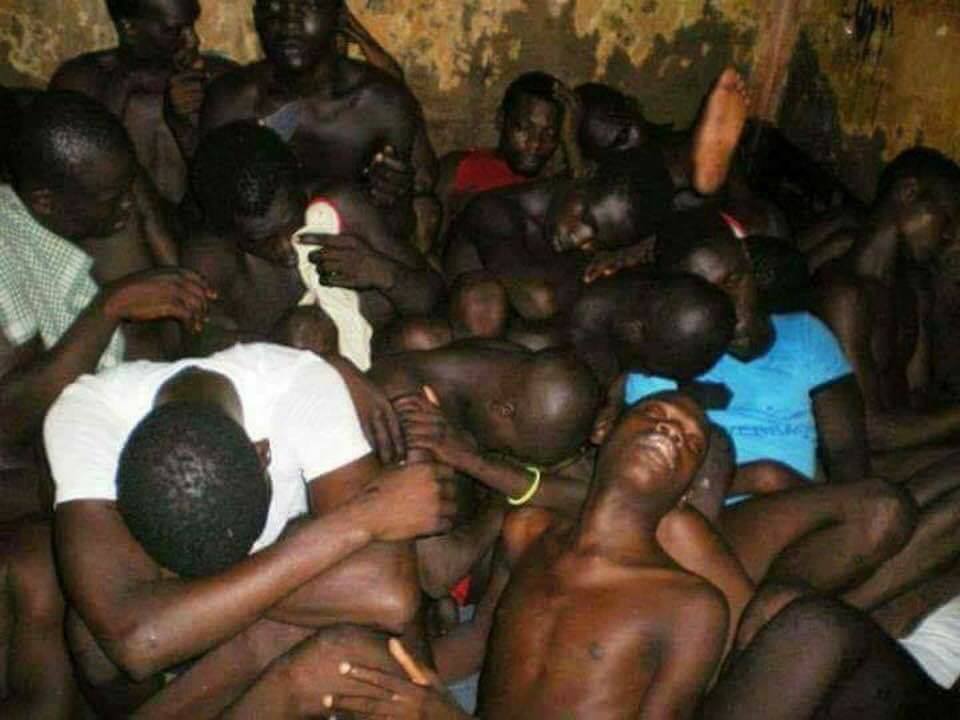
A video of men appearing to be sold at auction in Libya for $400 has shocked the world and focused international attention on the exploitation of migrants and refugees the north African country.
The footage and subsequent investigation conducted by CNN last month has rallied European and African leaders to take action to stop the abuses. On Wednesday, the leaders of Libya, France, Germany, Chad and Niger and four other countries agreed on a plan to evacuate thousands of migrants stuck in Libyan detention camps.
The grainy undercover video appears to show smugglers selling off a dozen men outside of the capital city Tripoli.
“Does anybody need a digger? This is a digger, a big strong man, he’ll dig,” said an auctioneer, according to CNN. “What am I bid, what am I bid?”
The report has drawn attention to an issue that aid and migrant groups say has gone on for years.
Why is there a slave trade in Libya?
Libya is the main transit point for refugees and migrants trying to reach Europe by sea. In each of the last three years, 150,000 people have made the dangerous crossing across the Mediterranean Sea from Libya. For four years in a row, 3,000 refugees have died while attempting the journey, according to figures from the International Organization for Migration (IOM), the U.N.’s migration agency.
The Libyan Coast Guard — supported with funds and resources from the E.U. and more specifically, Italy — has cracked down on boats smuggling refugees and migrants to Europe. With estimates of 400,000 to almost one million people now bottled up Libya, detention centers are overrun and there are mounting reports of robbery, rape, and murder among migrants, according to a September report by the U.N. human rights agency. Conditions in the centers have been described as “horrific,” and among other abuses, migrants are vulnerable to being sold off as laborers in slave auctions.
“It’s a total extortion machine,” Lenard Doyle, Director of Media and Communications for the IOM in Geneva tells TIME. “Fueled by the absolute rush of migrants through Libya thinking they can get out of poverty, following a dream that doesn’t exist.”
The IOM said in April that it had documented reports of “slave markets” along the migrant routes in North Africa “tormenting hundreds of young African men bound for Libya.”
“There they become commodities to be bought, sold and discarded when they have no more value,” Doyle said in the April statement.
Woman busted in NYC rabbi syringe attack allegedly stabbed another Jewish man hours earlier: report
Ilhan Omar Accused of Leaking Info to Foreign Leaders in Somalia as Resurfaced Post Brings Evidence to Light
Airbnb Cracks Down on Hosts Treating Guests Like a Free Maid Service
How Is This Legal? Pollster Boosting Dem in Mississippi Admits It Fabricated Most Election Surveys
MAPPED: The states Trump and top Democrats are targeting before Election Day
Young Voters Who Helped Hand Trump White House Are Flocking Back to Dems for the Midterms: Poll
‘Pay the Community’: Trump Pushes Builders to Give Local Americans Extra Payday to Put Up with Unpopular Data Centers
5 victims released from hospital after Florida A&M University shooting, 1 remains critical
‘Nothing Compared to What Is Coming’: Bukele Issues Stark Warning to Haitian Gangs
Trump immigration win could strengthen admin’s hand in looming Supreme Court fight
‘MASH’ and ‘Top Gun’ Star Dead at 93
Is Our Constitution Adequate to Resist Sharia
Six Flags to add seat belts to roller coasters after Georgia rider’s death
Hochul faces revolt from unlikely New Yorkers as Democrats deliver scathing verdict on their party
Man admits beating dad to death in picturesque town decades ago after bragging to cops about ‘first body’
How is Libya handling the crisis?
According to CNN, the U.N.-backed Libyan government has launched a formal investigation into the allegations. But Libya is largely considered a failed state. Since Muammar Gaddafi, who ran the country for four decades, was ousted in 2011, the country has descended into civil war. A transitional government failed to implement rule of law in the country, which has splintered into several factions of militias, tribes, and gangs. In lawless Libya, many see the slave trade and smuggling as a lucrative industry. Tackling the country’s humanitarian crisis will require international assistance.
On Wednesday, Libya reached a deal with E.U. and African leaders to allow the emergency repatriation of refugees and migrants facing abuse in its detention centers. The government also agreed to open a transit center for vulnerable refugees after months of negotiations, according to Reuters. The center is intended to safely house people before they are resettled or sent to a third country.
How is the international community responding?
Following the publication of the video, there was outcry from all corners of the globe, with some nations recalling their ambassadors from Libya. Protesters rallied outside Libyan embassies across Africa and in Europe.
On Wednesday, African and European leaders met at a summit in the Ivory Coast and agreed on an urgent evacuation plan that would see about 15,000 people flown out of Libya. Most of the migrants will be sent back to their home countries. Speaking at the summit, French President Emmanuel Macron, called the abuse “a crime against humanity” and vowed the summit members would “launch concrete military and policing action on the ground to dismantle those networks,” according to the Guardian. The deal also included initiatives to target traffickers, including setting up a task force to dismantle trafficking networks, the BBC reports.
Nigerian President Muhammadu Buhari expressed shock at how his compatriots were being treated “like goats.” On Wednesday, 242 Nigerian migrants were flown out of Libya back to Nigeria.
The day before, the U.N. Security Council held an emergency meeting and said it would be “stepping up its work” to stop the abuses. However, the U.N refugee agency said it faces “dramatic” funding gaps, especially for its operations in sub-Saharan Africa. “Slavery and other such egregious abuses of human rights have no place in the 21st century,” U.N. Secretary-General António Guterres said.
Since 2015, the IOM has repatriated 13,000 people from Libya under a voluntary program. But Doyle, the IOM spokesperson, says more needs to be done to stop migration at its core, particularly from tech companies who own online platforms where traffickers can falsely lure people into paying smugglers.
“They’re being completely misled into thinking that’s a happy future for them and being misled thorough social media,” he tells TIME.
Earlier this week, the foreign ministry of Rwanda said it would extend asylum to 30,000 mainly sub-Saharan Africans stuck in Libya. “Given our own history … we cannot remain silent when human beings are being mistreated and auctioned off like cattle,” the foreign ministry said.
U.S. Ambassador to the U.N. Nikki Haley condemned the abuses, saying: “To see the pictures of these men being treated like cattle, and to hear the auctioneer describe them as, quote, ‘big strong boys for farm work,’ should shock the conscience of us all.”
“There are few greater violations of human rights and human dignity than this.”
Story cited here.


