







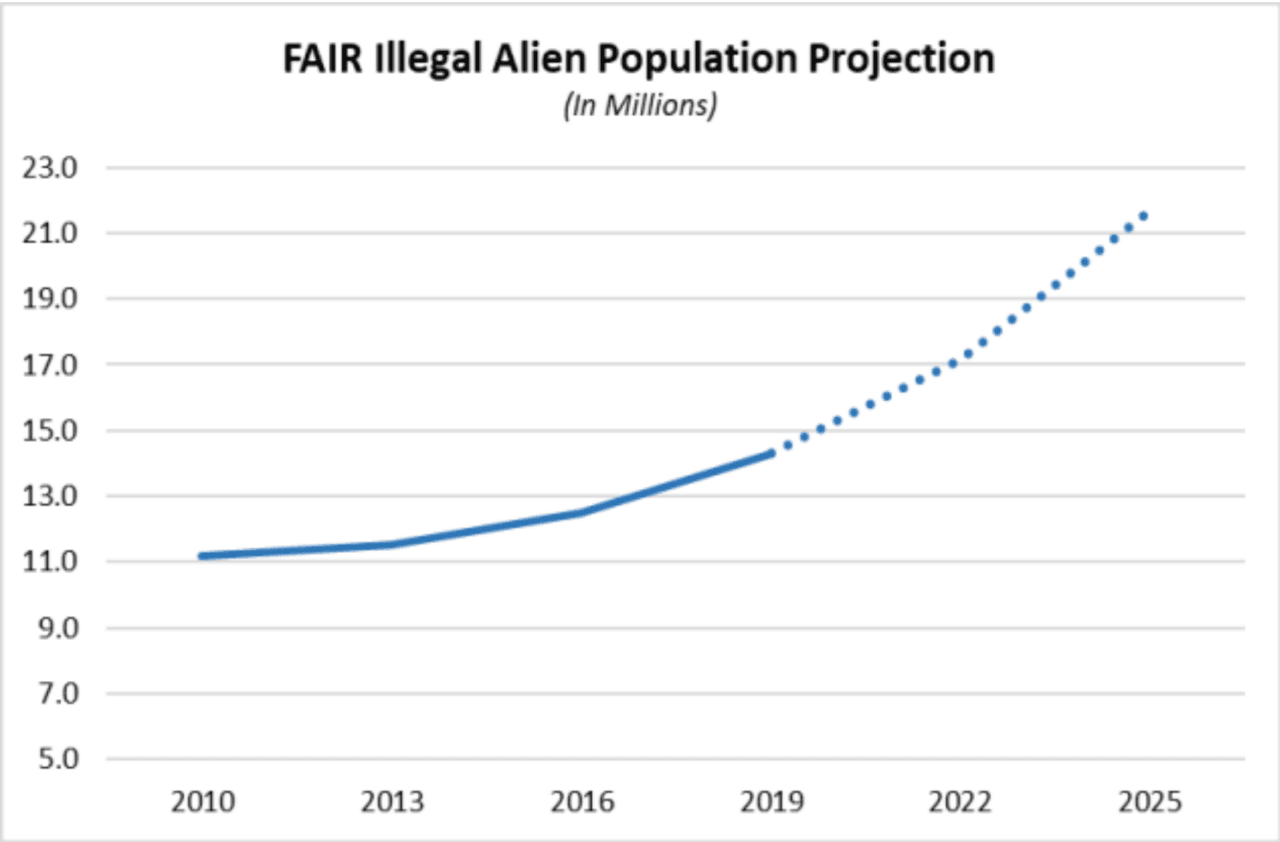
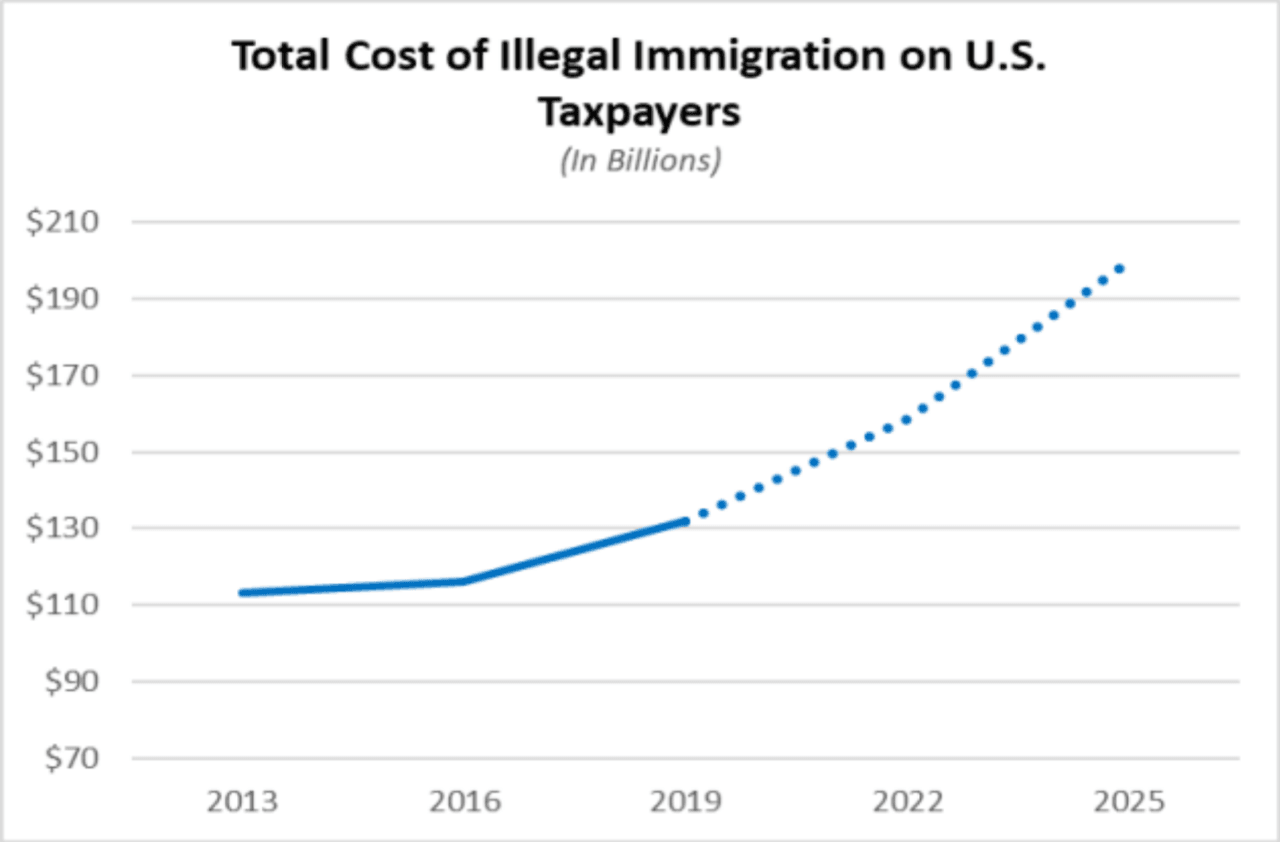
About 14.3 million illegal aliens are living across the United States, according to a new study, costing American taxpayers roughly $132 billion a year.
An annually released report by the Federation for American Immigration Reform (FAIR) estimates that that illegal population living in the U.S. has risen nearly two million in two years, now standing at about 14.3 million illegal aliens.
FAIR analysts fault the increase in illegal aliens to an unsecured southern border, growing sanctuary city policies, widespread available U.S. jobs with no nationwide E-Verify mandate, an increase in social welfare programs, exploitable asylum laws, and the ongoing promise of amnesty by GOP and Democrat lawmakers.
Halima Salman convicted of receiving ISIS military training in Syria, faces 10 years in prison
Harley-Davidson’s Decade-Long Electric Motorcycle Initiative Has Turned Disastrous
Rock Legend Donnie Iris Dies Less Than Three Weeks After Retiring from Performing
Federal officials identify 400 noncitizens registered to vote in Washington state: ‘Tip of the iceberg’
Cassidy Hutchinson avoids indictment after DOJ effort to charge her over Jan 6 testimony fails: sources
Man accused of threatening to hijack United flight says it was a drunken joke
Watch: Outrageous Pro-El-Sayed Ad Blames Jewish State for Raising Price of Bananas, Eggs in Michigan
Haitian illegal immigrant charged in Walmart killing entered US via Biden parole program: DHS
Flavio Bolsonaro to be issued visa by State Department after fleeing Brazil
Right-Wing Presidential Candidate Flavio Bolsonaro Secretly Flees Brazil for US After Disputed Election: Report
Luxury real estate brothers sentenced to 30 years in prison for yearslong sex-trafficking scheme
Judge who apologized to accused would-be Trump assassin lights up DOJ in Hunter Biden FBI case
Jordanian Military Goes After Targets in Syria in Response to Terrorists Killing Christians
‘Beloved’ daredevils who scaled Empire State Building inching toward deal after proposal stunt: attorney
Judge slams federal prosecutors over new charges against ex-FBI officials
The rise in the illegal population, FAIR analysts find, means illegal aliens are costing American taxpayers nearly $132 billion every year. That fiscal burden to Americans is set to grow even larger without major immigration-reducing reforms, according to the study.
Halima Salman convicted of receiving ISIS military training in Syria, faces 10 years in prison
Harley-Davidson’s Decade-Long Electric Motorcycle Initiative Has Turned Disastrous
Rock Legend Donnie Iris Dies Less Than Three Weeks After Retiring from Performing
Federal officials identify 400 noncitizens registered to vote in Washington state: ‘Tip of the iceberg’
Cassidy Hutchinson avoids indictment after DOJ effort to charge her over Jan 6 testimony fails: sources
Man accused of threatening to hijack United flight says it was a drunken joke
Watch: Outrageous Pro-El-Sayed Ad Blames Jewish State for Raising Price of Bananas, Eggs in Michigan
Haitian illegal immigrant charged in Walmart killing entered US via Biden parole program: DHS
Flavio Bolsonaro to be issued visa by State Department after fleeing Brazil
Right-Wing Presidential Candidate Flavio Bolsonaro Secretly Flees Brazil for US After Disputed Election: Report
Luxury real estate brothers sentenced to 30 years in prison for yearslong sex-trafficking scheme
Judge who apologized to accused would-be Trump assassin lights up DOJ in Hunter Biden FBI case
Jordanian Military Goes After Targets in Syria in Response to Terrorists Killing Christians
‘Beloved’ daredevils who scaled Empire State Building inching toward deal after proposal stunt: attorney
Judge slams federal prosecutors over new charges against ex-FBI officials
Halima Salman convicted of receiving ISIS military training in Syria, faces 10 years in prison
Harley-Davidson’s Decade-Long Electric Motorcycle Initiative Has Turned Disastrous
Rock Legend Donnie Iris Dies Less Than Three Weeks After Retiring from Performing
Federal officials identify 400 noncitizens registered to vote in Washington state: ‘Tip of the iceberg’
Cassidy Hutchinson avoids indictment after DOJ effort to charge her over Jan 6 testimony fails: sources
Man accused of threatening to hijack United flight says it was a drunken joke
Watch: Outrageous Pro-El-Sayed Ad Blames Jewish State for Raising Price of Bananas, Eggs in Michigan
Haitian illegal immigrant charged in Walmart killing entered US via Biden parole program: DHS
Flavio Bolsonaro to be issued visa by State Department after fleeing Brazil
Right-Wing Presidential Candidate Flavio Bolsonaro Secretly Flees Brazil for US After Disputed Election: Report
Luxury real estate brothers sentenced to 30 years in prison for yearslong sex-trafficking scheme
Judge who apologized to accused would-be Trump assassin lights up DOJ in Hunter Biden FBI case
Jordanian Military Goes After Targets in Syria in Response to Terrorists Killing Christians
‘Beloved’ daredevils who scaled Empire State Building inching toward deal after proposal stunt: attorney
Judge slams federal prosecutors over new charges against ex-FBI officials
“Unless the federal government takes meaningful action to eliminate the incentives that fuel illegal immigration, the total number of illegal aliens residing in the United States could surge to over 21 million by 2025, at a cost of nearly $200 million, annually,” FAIR analysts project.
The FAIR study is among many that have attempted to estimate the illegal population living in the U.S. Researchers from Yale University and the Massachusetts Institute of Technology have estimated an illegal population of 22 million, while Pew Research Center regularly cites an illegal population of 11 to 12 million.
As noted previously, the FAIR study confirms that the illegal population is largely concentrated in six states: California, Texas, Florida, New York, New Jersey, and Illinois — four of which are sanctuary states where criminal illegal aliens are shielded from deportation.
California, for example, is home to more than three million illegal aliens with the broadest sanctuary state policy in the country. Texas has an illegal population of more than two million, and Florida is home to nearly 1.1 million illegal aliens despite both outlawing sanctuary city jurisdictions.
Halima Salman convicted of receiving ISIS military training in Syria, faces 10 years in prison
Harley-Davidson’s Decade-Long Electric Motorcycle Initiative Has Turned Disastrous
Rock Legend Donnie Iris Dies Less Than Three Weeks After Retiring from Performing
Federal officials identify 400 noncitizens registered to vote in Washington state: ‘Tip of the iceberg’
Cassidy Hutchinson avoids indictment after DOJ effort to charge her over Jan 6 testimony fails: sources
Man accused of threatening to hijack United flight says it was a drunken joke
Watch: Outrageous Pro-El-Sayed Ad Blames Jewish State for Raising Price of Bananas, Eggs in Michigan
Haitian illegal immigrant charged in Walmart killing entered US via Biden parole program: DHS
Flavio Bolsonaro to be issued visa by State Department after fleeing Brazil
Right-Wing Presidential Candidate Flavio Bolsonaro Secretly Flees Brazil for US After Disputed Election: Report
Luxury real estate brothers sentenced to 30 years in prison for yearslong sex-trafficking scheme
Judge who apologized to accused would-be Trump assassin lights up DOJ in Hunter Biden FBI case
Jordanian Military Goes After Targets in Syria in Response to Terrorists Killing Christians
‘Beloved’ daredevils who scaled Empire State Building inching toward deal after proposal stunt: attorney
Judge slams federal prosecutors over new charges against ex-FBI officials
The sanctuary states of New York, New Jersey, and Illinois have a combined illegal population of about 2.22 million.
Illegal immigration is not only fiscally burdensome on American taxpayers to the sum of billions every year, but an increase of foreign workers in the U.S. labor market due to legal immigration levels — where about 1.2 million immigrants are admitted every year — reduces the wages of America’s working and middle class. Conversely, less immigration increases Americans’ wages.
Extensive research by economist George Borjas and analyst Steven Camarota reveals that the country’s current mass legal immigration system burdens working and middle class Americans while redistributing about $500 billion in wealth every year to major employers and newly arrived immigrants. Similarly, immigration keeps wages low for employers and stagnant for employees.
For every one-percent increase in the immigrant portion of American workers’ occupations, their weekly wages are cut by about 0.5 percent, Camarota finds. This means the average native-born American worker today has his weekly wages reduced by perhaps 8.75 percent.
Today, about 17.5 percent of the American workforce is made up of foreign-born workers. About 7.8 million of these foreign-born workers are illegal aliens living in the U.S., according to the latest analysis by Pew Research Center.
Story cited here.


